
Vernex targets the telecoms operations crunch
Vernex targets the telecoms operations crunch
Vernex Networks has launched Vernex Automate, a network automation platform aimed at helping telecoms operators deal with one of their fastest-growing operational problems: complexity.
Vernex Networks has launched Vernex Automate, a network automation platform aimed at helping telecoms operators deal with one of their fastest-growing operational problems: complexity.
As mobile and fixed networks carry more traffic, support more services and rely on increasingly distributed infrastructure, the job of keeping them running has become harder. For many operators, network teams are still working through large volumes of alarms, tickets and dashboards, often under pressure to fix faults before customers notice any degradation to service.
Vernex Automate is designed to reduce that burden by combining AI-assisted event correlation, workflow automation and operational reporting in a single platform.
Why this matters now
Why this matters now
Telecoms networks have become critical infrastructure for everyday life, from remote working and digital payments to connected devices and enterprise services. When networks fail, the impact is no longer limited to dropped calls or slow downloads – it stops a business functioning.
At the same time, operators are being asked to improve service reliability while controlling costs. Hiring more engineers or adding more monitoring tools is not always practical. The bigger challenge is helping existing teams understand which issues matter, what is causing them and what action should come next.
That is the gap Vernex is trying to address.
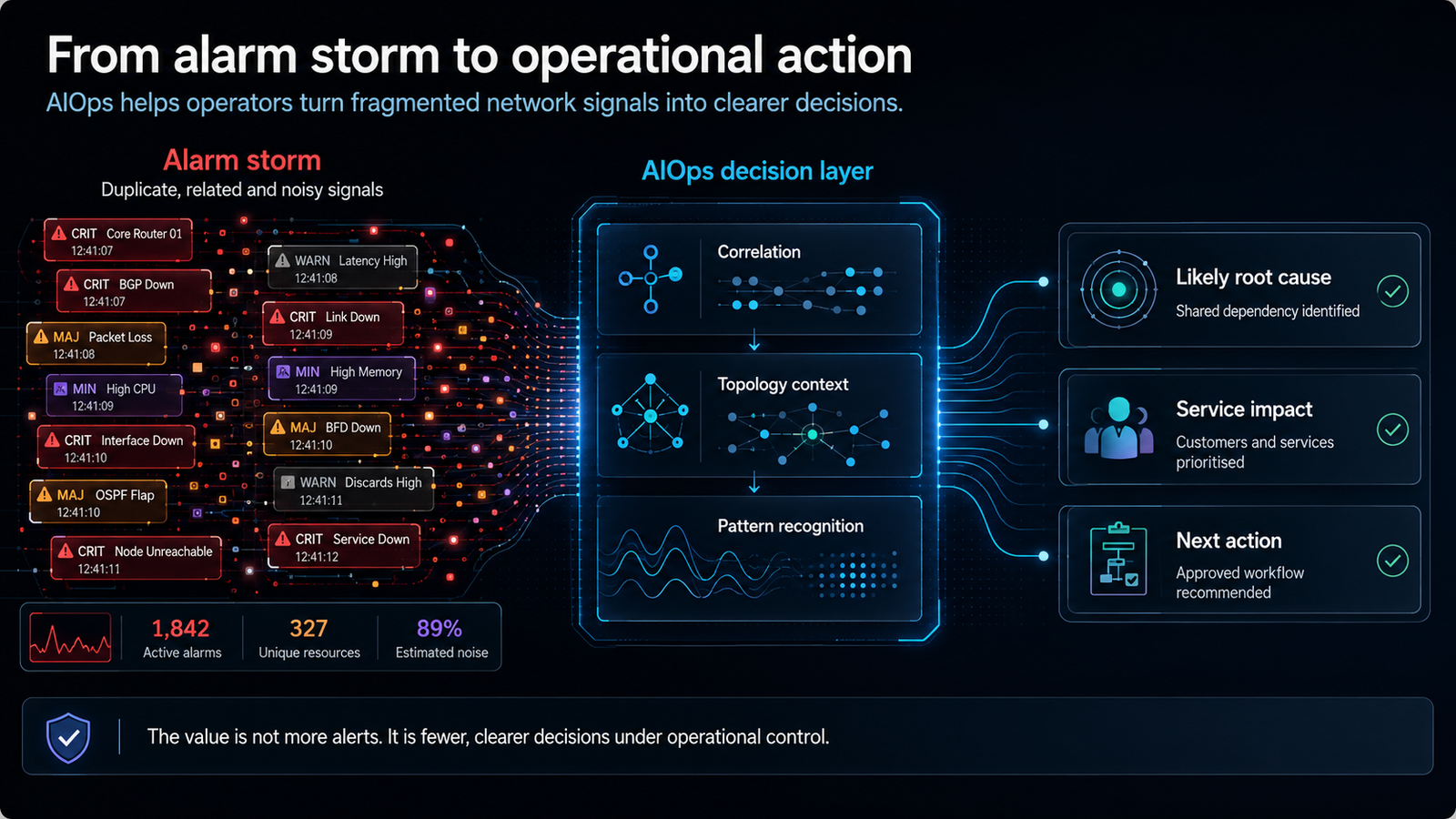
From alarm overload to operational clarity
From alarm overload to operational clarity
Vernex Automate is designed to help operations teams cut through network noise, identify what matters and move from diagnosis to controlled action.
The platform is built around three modules:
- EventIQ: Analyses alarms and telemetry from multiple systems, groups related events and highlights likely root causes. Vernex says it can reduce alarm noise by up to 85% in targeted deployments.
- FlowOps: Turns approved remediation steps into repeatable workflows, with rules for confidence levels, maintenance windows and engineer approvals.
- Insights: Tracks network health, repeat faults, repair times, service-impacting incidents and automation performance.
Together, the modules help operators move beyond simply spotting faults and towards resolving them faster, more safely and with greater consistency.
Automation, but not at any cost
Automation, but not at any cost
A key part of the platform is control. Vernex Automate can be used in advisory mode, require engineer approval before action is taken, or automatically carry out defined low-risk tasks.
The company says the product includes role-based access, audit logs, policy guardrails, rollback workflows and simulation tools for higher-risk scenarios.
That matters because operators are often cautious about automation in live networks. The promise of closed-loop operations is attractive, but few teams want critical systems making unchecked decisions.
A practical route forward
A practical route forward
Vernex says operators are likely to start with repetitive, high-volume tasks such as alarm deduplication, ticket enrichment, repeat-fault analysis and standard remediation workflows.
Sarah Vance, chief executive of Vernex Networks, said the platform was built to help teams “cut through complexity” while keeping engineers in control.
Future versions are expected to add natural-language features, allowing engineers to ask plain-language questions about network events and recurring faults.