owned content makes every other channel work harder
owned content makes every other channel work harder
Paid, earned, social and outreach all create attention. Owned creates depth
Paid, earned and social channels can create attention. Owned content is where that attention turns into trust, proof and action. This is why B2B companies need a stronger owned media strategy, not just another blog calendar.
Have the owned channels taken a back seat?
In a word, yes.
Marketing has become very good at chasing attention. It has become less disciplined about what happens after it gets it.
Businesses spend time, money and energy reaching audiences through paid, earned and social channels, then too often send that attention back to owned channels that are underdeveloped, underused or treated as somewhere to park the occasional blog.
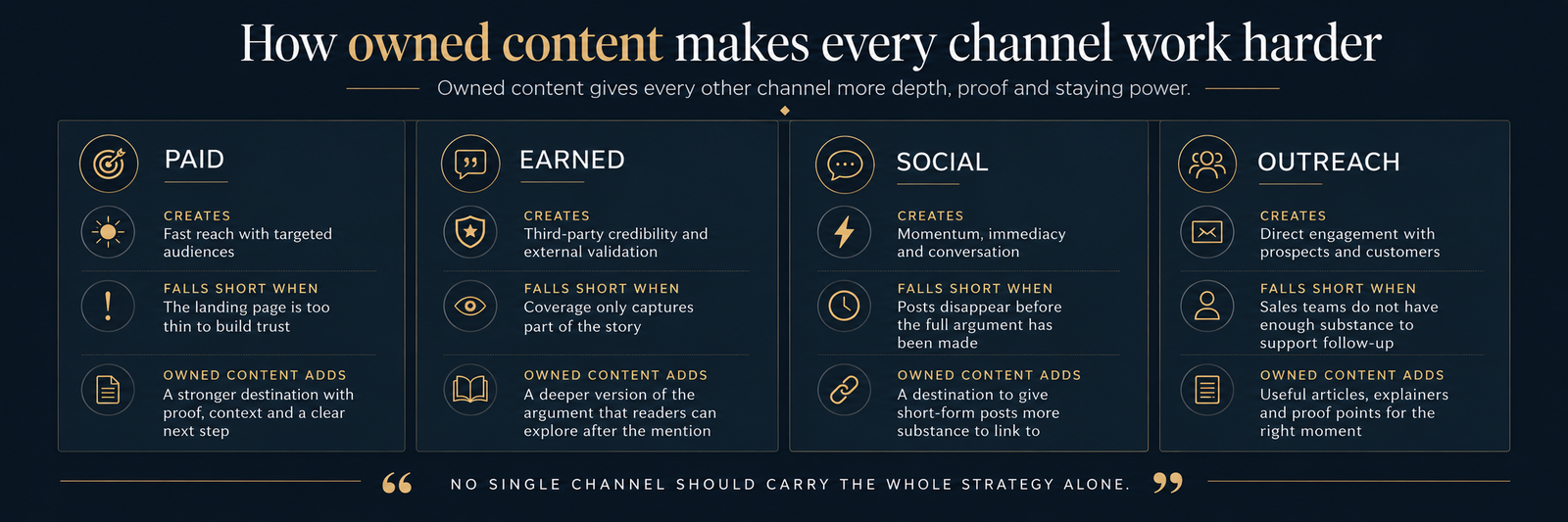
That is the strange imbalance at the heart of modern marketing. The channels designed to distribute the message often get more strategic attention than the channels designed to hold it. Paid gives you reach. Earned gives you credibility. Social gives you immediacy.
But owned content is where the argument is built, the proof is organised and passing interest is turned into something more durable.
What happens when campaign thinking never reaches owned channels?
It always feels like there is something missing.
For the British readers, think back to The Inbetweeners Movie. On the first night out in Malia, the boys are tempted into a club by a flirtatious promoter only to discover an empty room with a bar. You could immediately see the disappointment on their faces.
The same could be said of many marketing strategies.
LinkedIn audiences are tempted to click a link by a provocative post only to be taken directly to a product page. The audience is asked to go from curiosity to commitment in a matter of seconds. It assumes the audience is at the final stages of the buying journey.
This can work, but rarely does. Research from Gartner suggests 60% of the purchase process happens before buyers engage with sellers.
Customers should be guided towards the right decision, from educational and informative content, transitioning towards more sales-orientated messaging.
What is owned channel content?
Owned channel content is content a company publishes on platforms it controls, such as its website, blog, or resource hub.
It gives paid, earned and social activity somewhere useful to send people, helping turn attention into trust, understanding and action.
Why does content matter so much?
Content matters because attention does not automatically become trust.
According to Edelman’s 2025 B2B thought leadership research, decision makers are more likely to consider companies that publish high-quality thought leadership. Content Marketing Institute research also shows many B2B marketers still struggle to build scalable, effective content strategies.
These numbers should not come as a surprise to most. After all, before you can sell, the customer must first trust the brand and that is what content delivers.
Every interaction with the audience is a different step of a journey. We move the audience through the funnel from grabbing attention, building understanding, gaining trust, developing intent and finally towards action.
Owned adds depth to the credibility, reach and immediacy developed through earned, paid and social:
- It educates on a problem the audience may not fully understand
- Explains a shift in a market and the impact to the audience
- Shows why a company is credible in a space
- Gives social posts or emails a destination on the company’s domain
- Supports sales conversations with proof and context
- Turns announcements into long-term conversations rather than one-off moments
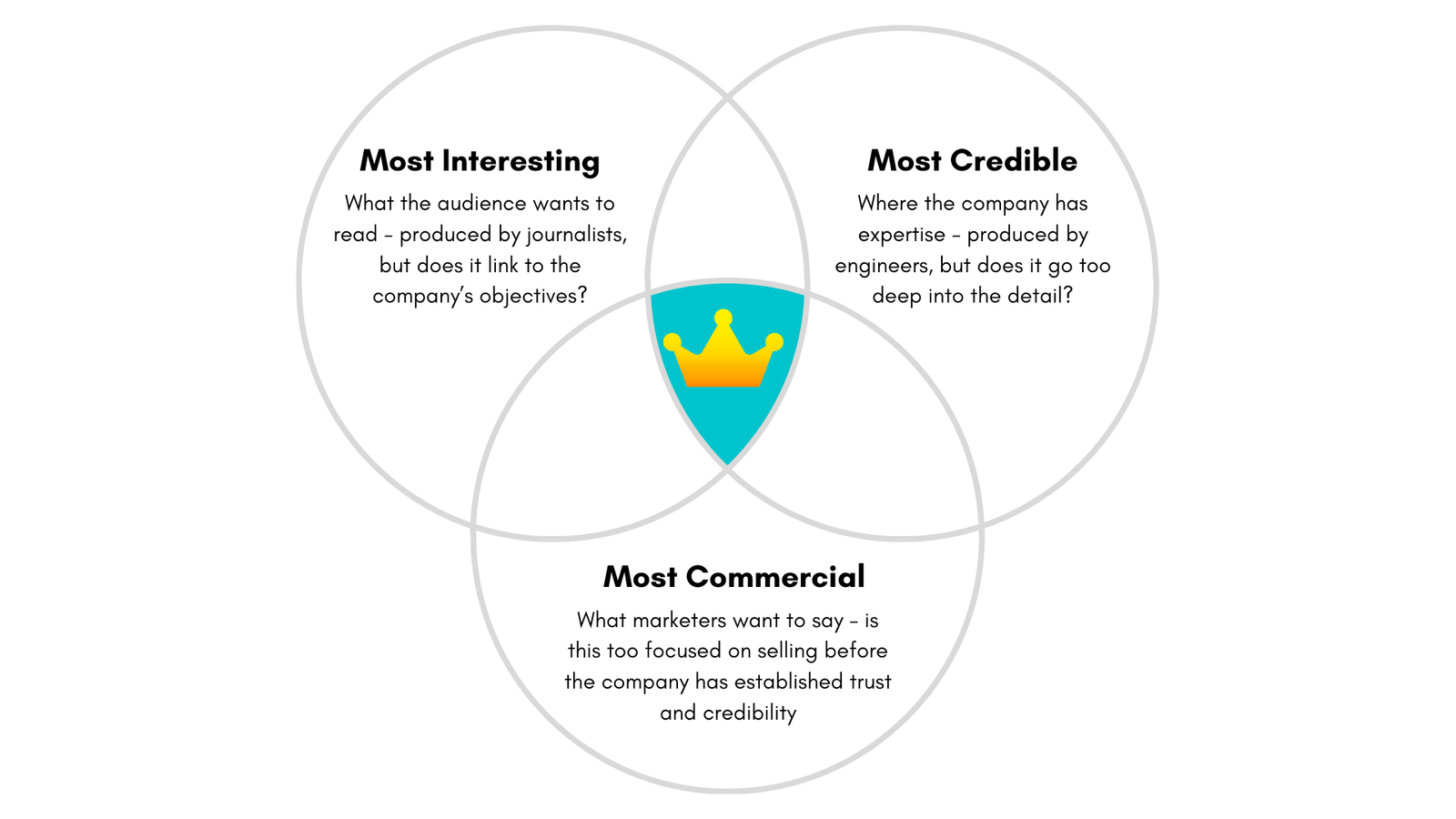
Good quality content sits in the centre of an interesting Venn diagram. Too often, content is either too technical, too sales-orientated or lacks a company link.
The sweet spot in the middle is where experienced writers who dedicate time to the craft operate.
Middle child syndrome
Owned channels have long been treated as the middle child of the marketing family: overlooked, underappreciated and given less attention than louder siblings such as paid, earned and social.
But that is starting to look like a mistake.
Paid may create reach. Earned may build credibility. Social may create momentum. But owned content is where companies build the argument, deepen the relationship and create something more durable.
The problem is not that owned content lacks value. It is that too few businesses have built the machinery to make it work properly.
The owned channels are not ineffective. They are underutilized.
The rise of The Content Store
The Content Store is our effort to change that.
Operating as a Fractional Editor, The Content Store works with companies to broaden the approach.
The problem is rarely a complete absence of strategy. Most companies already have messaging, campaign priorities, executive viewpoints and market narratives. The gap is execution: turning that thinking into owned-channel content that is planned, produced and useful enough to support the rest of the marketing mix.
We take the thinking already being developed for earned, paid and social, and apply it to owned channels through practical content plans and finished editorial assets. The emphasis is on doing: to create the articles, reports, case studies, explainers and campaign content that give those ideas a stronger, more permanent home.
Because owned content should not sit separately from the rest of the marketing mix. It should give every other channel something deeper, more useful and more credible to work with.
Over the next few weeks, we will look at how owned-channel content can do more than fill a website.
Done properly, it can help businesses:
- Strengthen social media engagement
- Support funnel marketing
- Give earned media more substance
- Build trust with customers and stakeholders
- Raise executive profiles
- Extend the impact of events
- Improve SEO and GEO performance
- Turn announcements into micro-campaigns
Owned content should not sit on the sidelines. It should give every other channel something stronger to work with.
Give your campaigns somewhere stronger to land
Paid, earned, social and outreach can create attention. We help turn that attention into credible owned content that builds trust, supports sales and gives your story a proper home.
Owned content FAQs
What is owned media?
Owned media is any content or channel a company controls directly, including its, blog, newsletter, reports, landing pages and resource hubs.
Why is owned content important in B2B marketing?
Owned content gives paid, earned, social and sales activity somewhere useful to send people. It helps explain the story, organise proof and build trust.
How does owned content support SEO?
Owned content gives search engines clear pages to index around the topics a company wants to be known for. It also supports internal linking and topical authority.
What is the difference between owned, earned and paid media?
Paid media is bought visibility. Earned media is third-party coverage or recognition. Owned media is content the company controls directly.
What types of owned content should companies create?
Useful owned content can include articles, explainers, case studies, reports, executive profiles, interviews, landing pages and campaign hubs.