Agentic AI is coming for the NOC. Telecoms needs guardrails before autonomy
Artificial Intelligence is increasingly cast as the villain of the labour market. That is too simple, and it lets organisations avoid the harder question. The problem is not AI, it is the adoption itself.
Artificial Intelligence is increasingly cast as the villain of the labour market. That is too simple, and it lets organisations avoid the harder question. The problem is not AI, it is the adoption itself.
Agentic AI is changing the telecoms automation debate.
For years, the industry has talked about smarter dashboards, better alarms and more intelligent recommendations. Agentic AI goes further. It introduces systems that can reason across data sources, call tools, trigger workflows and potentially take action across the network.
That is exciting.
It is also where the risk starts.
A telecoms network operations centre is not a sandbox. It is a live environment connected to customers, enterprises, emergency services and critical infrastructure. An AI agent cannot be allowed to “try things” and see what happens.
In telecoms, autonomy without boundaries is not innovation. It is an outage waiting for a reason.
The NOC is not a playground
The NOC is not a playground
The attraction of agentic AI is easy to understand.
Instead of waiting for an engineer to investigate an alarm, an agent could check related events, review topology, compare historic incidents, assess affected services and recommend the next best action.
In some cases, it could go further. It could open a ticket, suppress duplicate alarms, trigger a runbook or start a controlled workflow.
That could reduce pressure on engineering teams.
But only if the agent is working inside a very clear operating model.
Without that, the system does not reduce risk. It introduces a new kind of risk: automated action without enough context, control or accountability.
Every agent needs a permission model
Every agent needs a permission model
The real question is not whether AI agents can act.
The question is what they are allowed to touch.
Can they query service assurance systems? Can they inspect topology? Can they access change records? Can they trigger workflows? Can they restart a process? Can they reroute traffic? Can they escalate to field teams?
Each of those actions carries a different risk profile.
That means every agent needs a permission model. Operators need to define what the agent can see, what it can recommend, what it can execute and when it must stop and ask for approval.
This is not about slowing automation down.
It is about making automation safe enough to scale.
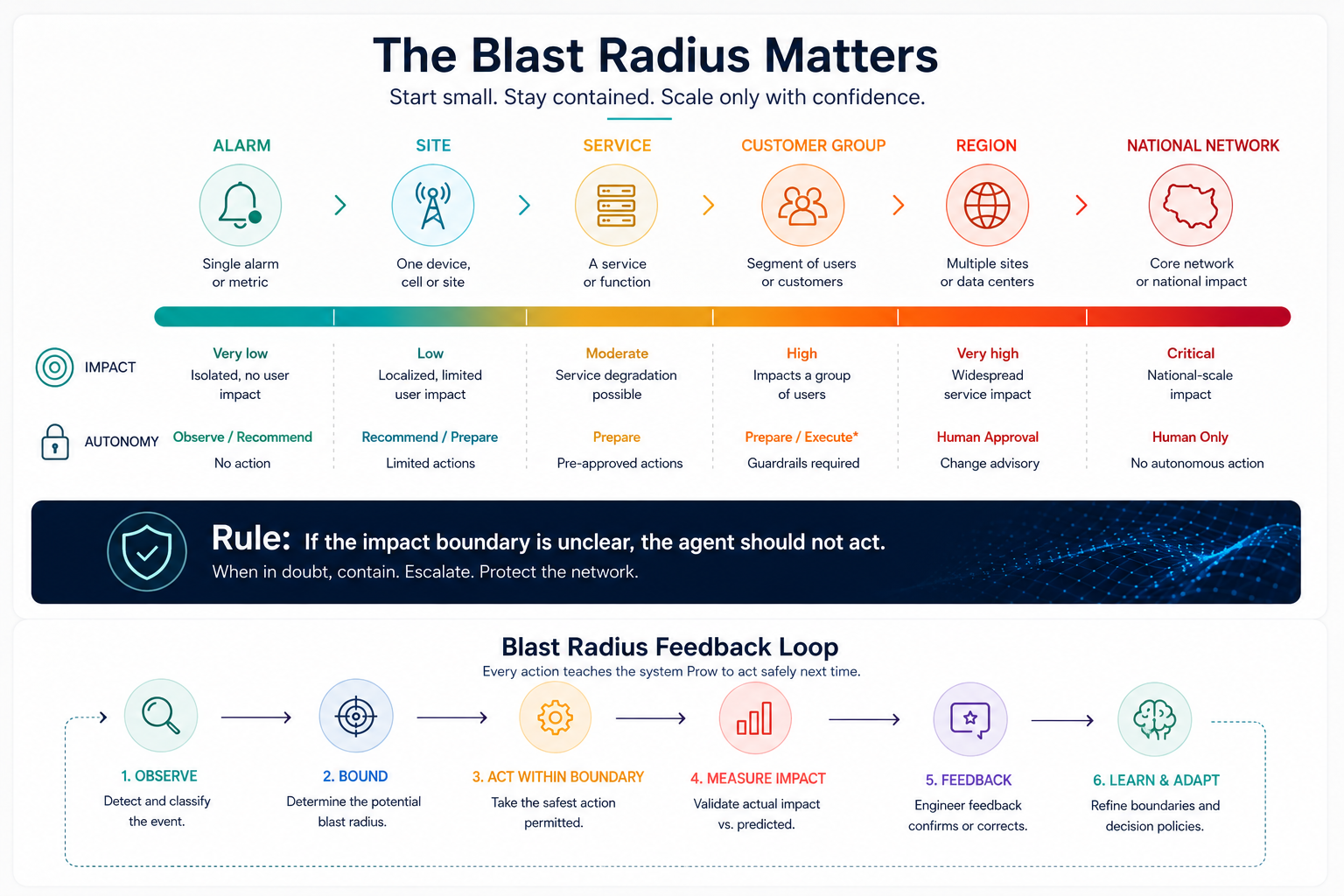
Agentic AI can only scale safely when its freedom is matched to the size of the potential impact. In telecoms, the wider the blast radius, the stronger the guardrails need to be.
Agentic AI can only scale safely when its freedom is matched to the size of the potential impact. In telecoms, the wider the blast radius, the stronger the guardrails need to be.
The blast radius matters
The blast radius matters
In software engineering, teams often talk about blast radius: how much damage can happen if something goes wrong.
Telecoms needs to apply the same thinking to agentic AI.
Before an agent acts, operators should know the maximum potential impact. Is the action limited to one alarm? One site? One service? One customer group? One region?
If the answer is unclear, the agent should not have permission to act.
This is where many automation programmes become too vague. They focus on the promise of speed, but not enough on the boundaries around that speed.
Fast is useful.
Fast and uncontrolled is dangerous.
Explainability is not optional
Explainability is not optional
Engineers will not trust agents because the model sounds confident.
They will trust them when the reasoning is visible.
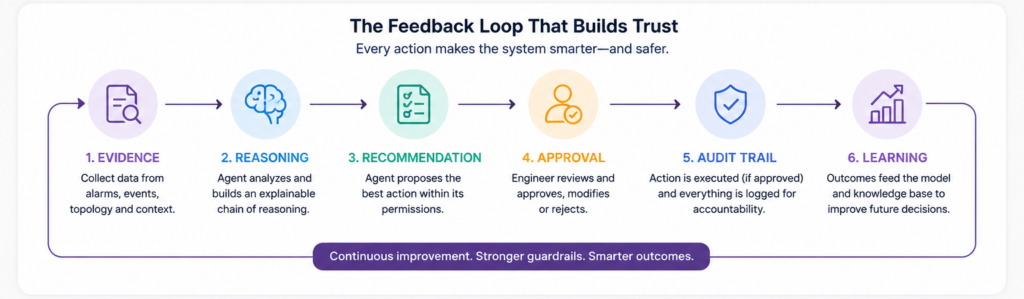
If an agent recommends an action, it should show the evidence: related alarms, affected services, recent changes, historic patterns, confidence level and fallback options.
That reasoning chain matters.
It allows engineers to challenge the recommendation. It supports audit trails. It helps teams learn from previous incidents. It also makes it easier to decide which actions can move from human-approved to fully automated over time.
Trust is not a cultural slogan.
In network operations, trust is architecture.
Controlled autonomy is the prize
Controlled autonomy is the prize
This is where Vernex sees the future of telecoms operations.
Not blind autonomy. Not another dashboard. Not AI theatre dressed up as transformation.
Controlled autonomy.
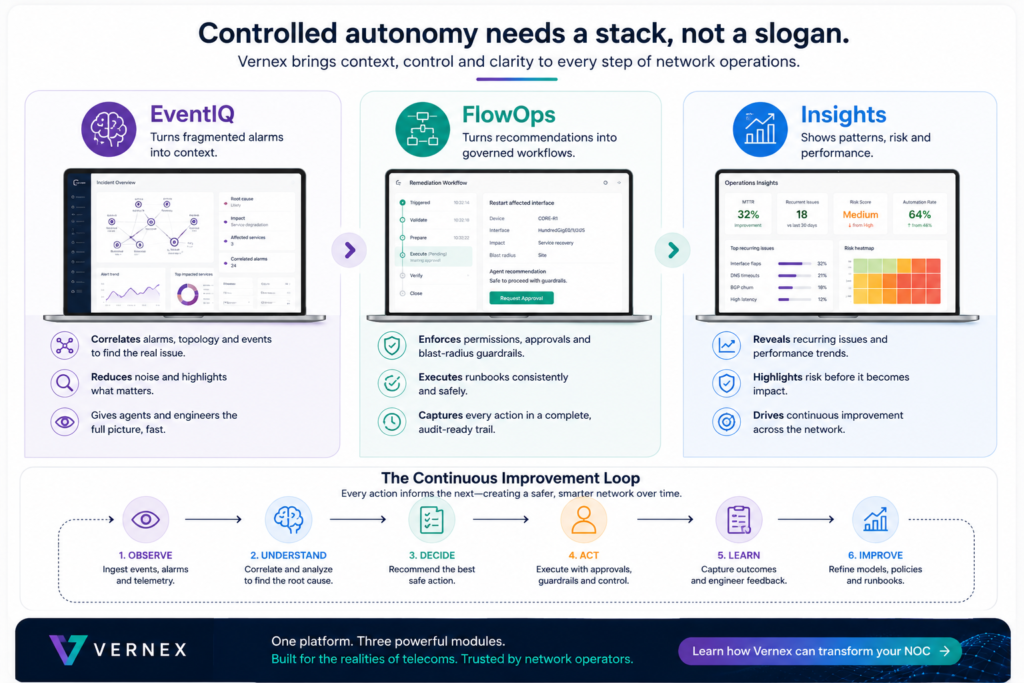
EventIQ helps operators turn fragmented alarms and incidents into a clearer operational picture. FlowOps helps convert recommended action into governed workflows. Insights gives teams visibility into recurring issues, risk patterns and operational performance.
Together, that creates the foundation agentic AI needs: context, control and confidence.
Because the future of telecoms automation will not be won by the operators that give AI the most freedom.
It will be won by the operators that give AI the right boundaries.
If you want agentic AI to work in the NOC, start with the guardrails. Then build the autonomy.
Find out how The Content Store can bring your stories to life