
AI Is a Productivity Tool, Not a Replacement Strategy
At Vernex, we believe AI should make people more productive, not make them disappear.
Used well, it helps teams move faster, reduce repetitive work, spot patterns earlier and make better decisions.
But too many AI deployments start from the wrong assumption: that automation can replace human judgement.
That is where risk creeps in. AI can be powerful, but it is not infallible.
Without human oversight, context and accountability, it can create errors at scale and damage trust.
The future is not blind automation. It is human-led AI, designed to support better work.
Why overconfident AI deployments risk damaging trust in the technology itself
Artificial intelligence is not failing because it lacks potential. It is failing, too often, because people are deploying it with the wrong expectations.
Across industries, organizations are rushing to insert AI into workflows, automate decisions, reduce headcount, and accelerate output. The appeal is obvious: faster work, lower costs, scalable systems, and fewer repetitive tasks. But much of today’s AI adoption is built on a dangerous assumption: that AI can simply replace human judgment.
It cannot.
At least, not reliably. Not yet. And not in many of the places where companies are currently trying to use it.
The real value of AI is not replacement. It is productivity. AI can help people work faster, see patterns sooner, draft more efficiently, summarize more information, and make better-informed decisions. But when organizations treat AI as a substitute for human understanding, they invite underperformance at best and serious harm at worst.
That distinction will determine whether AI becomes a trusted business tool or another overhyped technology that disappoints, disrupts, and triggers backlash.
The deployment problem
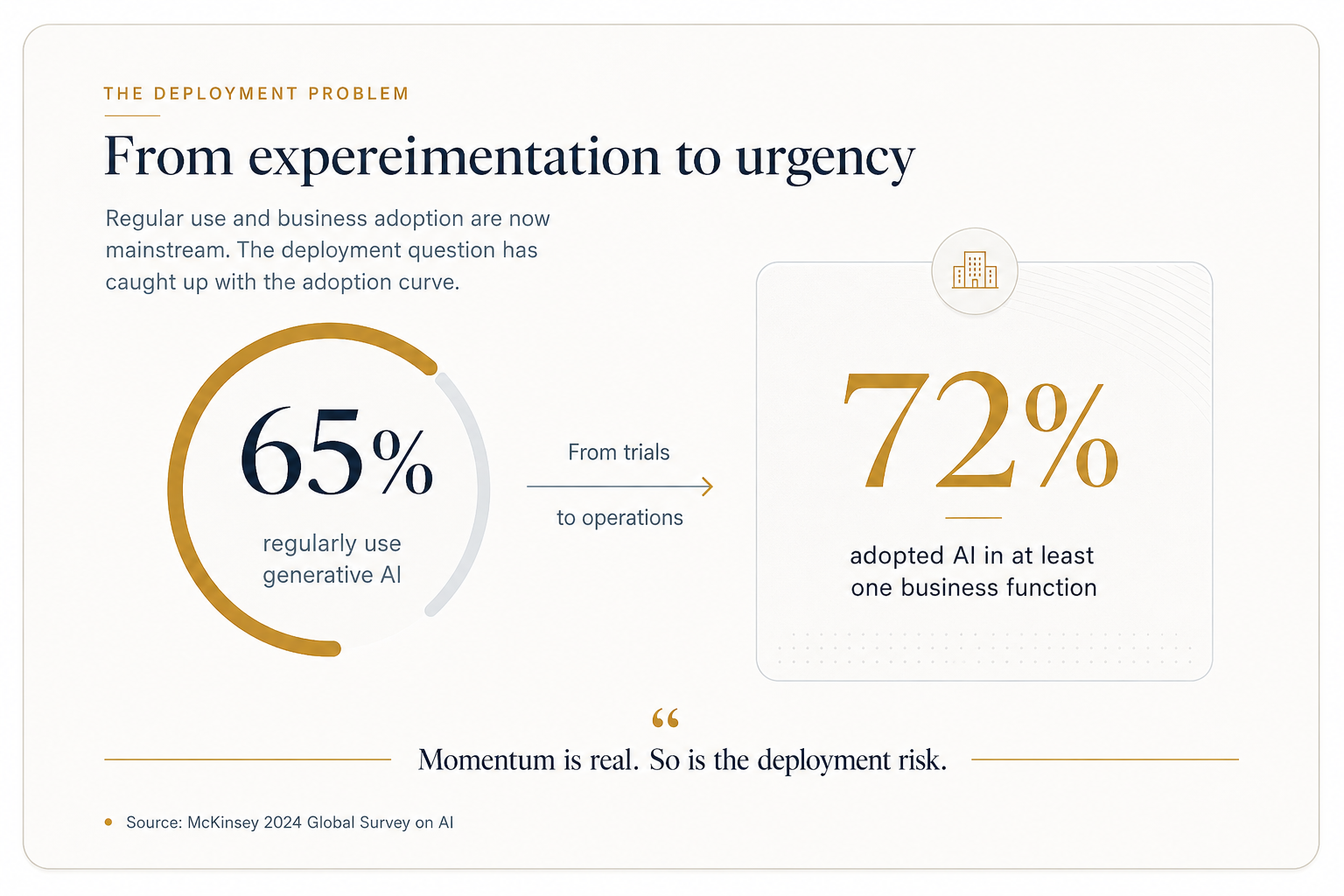
AI adoption has moved from experimentation to urgency. McKinsey’s 2024 Global Survey on AI found that 65% of organizations were regularly using generative AI, nearly double the previous year.
The same survey reported that 72% of organizations had adopted AI in at least one business function.
That momentum is real. So is the risk.
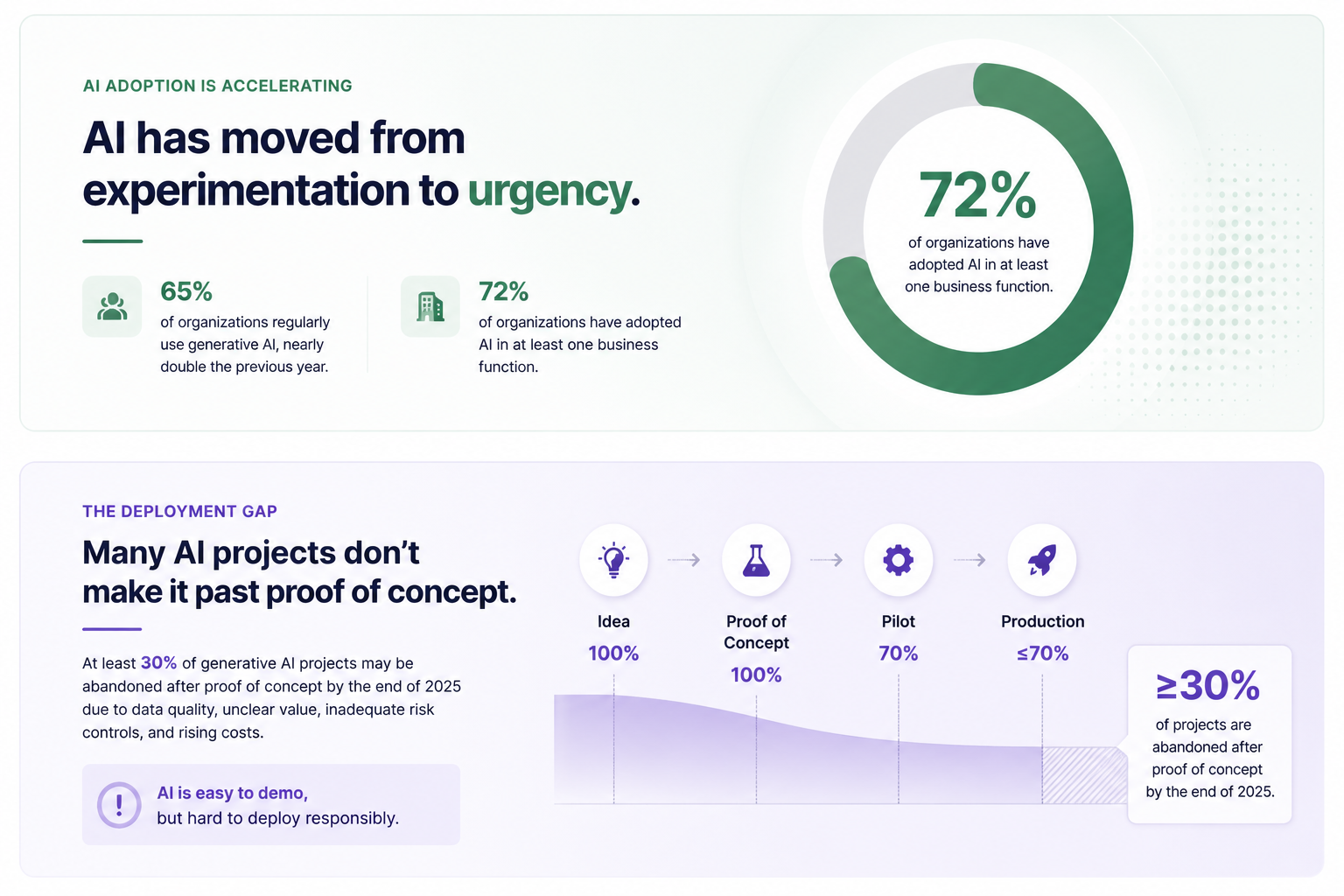
Gartner warned in 2024 that at least 30% of generative AI projects may be abandoned after proof of concept by the end of 2025, citing poor data quality, unclear business value, inadequate risk controls, and rising costs. This is the gap many organizations are now discovering: AI is easy to demo, but hard to deploy responsibly.
A model that performs well in a controlled test may struggle in the wild. Real business environments are messy. They involve exceptions, emotional nuance, legal exposure, incomplete data, legacy systems, customer relationships, and consequences that extend far beyond a single task.
That is where overconfidence becomes dangerous.
Many AI systems are “good enough” to impress, but not good enough to trust without supervision. They can draft a useful email, summarize a document, or identify a pattern. But they can also miss context, invent information, misread intent, or produce an answer that sounds right while being completely wrong.
In low-risk work, that may be inconvenient. In high-stakes work, it can be damaging.
The deployment problem
AI adoption has moved from experimentation to urgency. McKinsey’s 2024 Global Survey on AI found that 65% of organizations were regularly using generative AI, nearly double the previous year.
The same survey reported that 72% of organizations had adopted AI in at least one business function.
That momentum is real. So is the risk.
Gartner warned in 2024 that at least 30% of generative AI projects may be abandoned after proof of concept by the end of 2025, citing poor data quality, unclear business value, inadequate risk controls, and rising costs. This is the gap many organizations are now discovering: AI is easy to demo, but hard to deploy responsibly.
A model that performs well in a controlled test may struggle in the wild. Real business environments are messy. They involve exceptions, emotional nuance, legal exposure, incomplete data, legacy systems, customer relationships, and consequences that extend far beyond a single task.
That is where overconfidence becomes dangerous.
Many AI systems are “good enough” to impress, but not good enough to trust without supervision. They can draft a useful email, summarize a document, or identify a pattern. But they can also miss context, invent information, misread intent, or produce an answer that sounds right while being completely wrong.
In low-risk work, that may be inconvenient. In high-stakes work, it can be damaging.
Pretty good is not good enough everywhere
A core issue with AI deployment is that average performance can look better than it really is.
If an AI tool gives helpful output 80% of the time, that may seem impressive. But what happens in the other 20%? And who catches it? And how much damage can it cause before anyone notices?
This matters because AI operates at scale. A human mistake may affect one customer, one case, or one document. A poorly supervised AI system can repeat the same mistake thousands of times.
That is not efficiency. It is scaled-up error.
This is especially important where AI is being used in customer service, compliance, legal support, finance, HR, healthcare, insurance, and operational decision-making. These areas require more than pattern recognition. They require judgment. They require escalation.
They require an understanding of what happens next.
A human employee does not simply complete a task. They understand when something feels unusual. They know which customer needs care, which exception matters, which policy has changed, and which technically correct answer could still create a practical problem.
AI does not understand in that way. It predicts, generates, classifies, and recommends. That can be extremely useful, but it is not the same as human comprehension.
Hallucinations are a business risk, not a technical footnote
Generative AI can produce confident falsehoods. These are often called hallucinations, but the term can make the problem sound harmless. It is not harmless.
A hallucination can be a fake legal precedent, a false policy, an invented product feature, an inaccurate financial explanation, or a misleading medical statement. The danger is not only that AI gets things wrong. The danger is that it gets things wrong fluently.
That fluency is part of the problem. AI-generated answers often sound polished, complete, and authoritative. People are naturally inclined to trust confident language, especially when it is delivered quickly and neatly. But confidence is not accuracy.
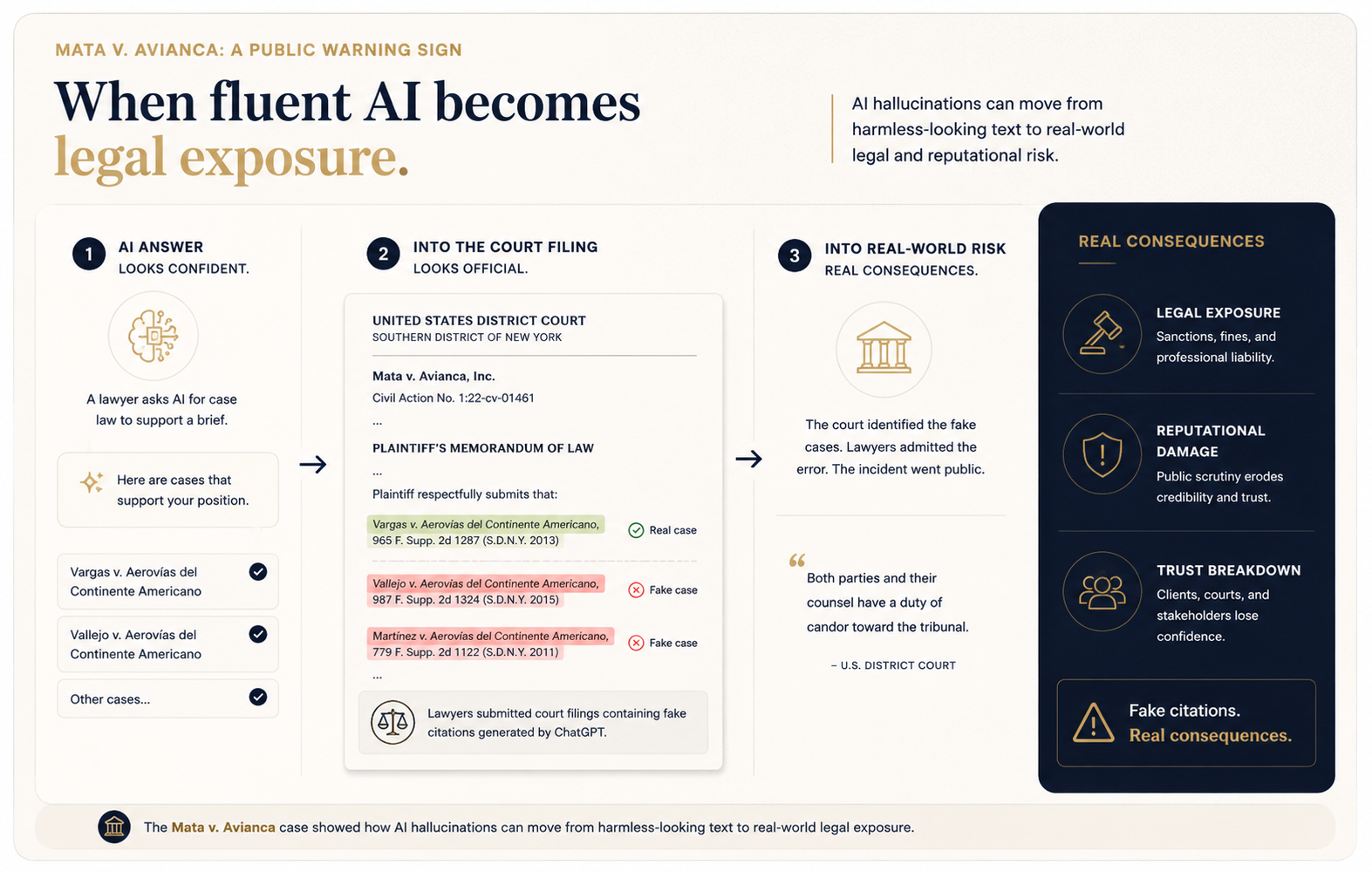
The legal case Mata v. Avianca became a public warning sign in 2023, after lawyers submitted court filings containing fake cases generated by ChatGPT. The technology produced plausible material. The humans failed to verify it. That combination is exactly where many AI deployments go wrong.
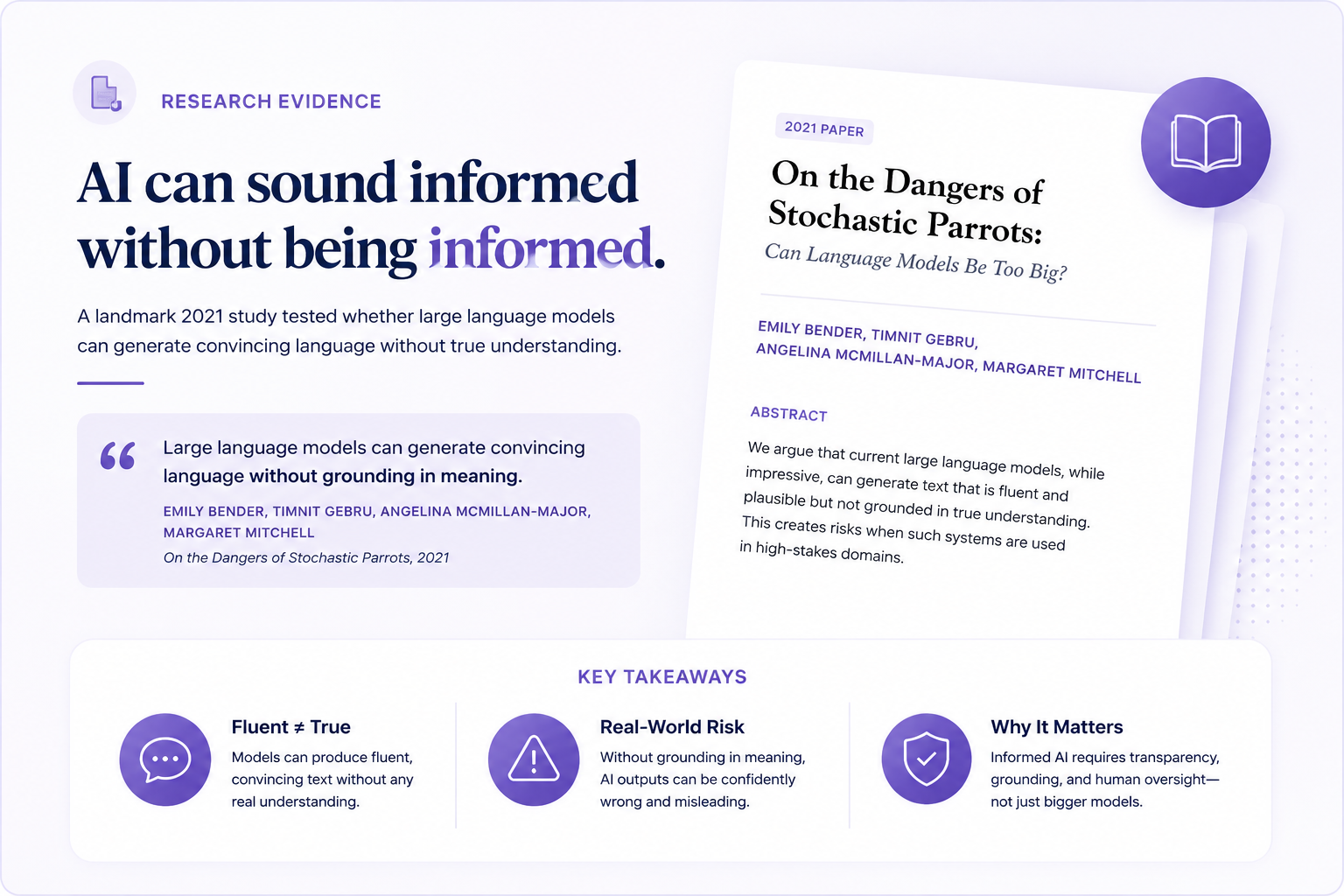
Researchers have warned about this for years. In the 2021 paper “On the Dangers of Stochastic Parrots,” Emily Bender, Timnit Gebru, Angelina McMillan-Major, and Margaret Mitchell argued that large language models can generate convincing language without genuine grounding in meaning. That insight remains central today: AI can sound informed without being informed.
For businesses, this creates a simple rule: AI output should not be treated as truth simply because it is well written.
Verification is not optional. Human review is not a decorative safeguard. It is the control that makes AI usable.
AI does not see the whole system
One of the biggest mistakes in AI deployment is asking only, “Can this task be automated?”
The better question is, “What changes if this task is automated?”
Business processes are connected. A customer service response can affect trust, retention, legal risk, brand perception, and future workload. A hiring screen can affect diversity, compliance, candidate experience, and company culture. A fraud detection system can block bad actors, but it can also punish legitimate customers if it is poorly designed.
AI systems are usually optimized for a specific output. Humans understand the wider consequences.
This is where the law of unintended consequences becomes a serious deployment issue. A system designed to reduce response times may frustrate customers. A tool built to lower costs may increase review work. A model trained on historical data may reproduce historical bias. A system introduced to replace employees may remove the very people needed to catch errors, handle exceptions, and maintain trust.
The U.S. National Institute of Standards and Technology recognized this complexity in its AI Risk Management Framework, published in 2023. NIST emphasizes that AI risks can emerge after deployment and require governance, monitoring, transparency, and human oversight.
That is the point: AI deployment is not a one-time implementation. It is an ongoing responsibility.
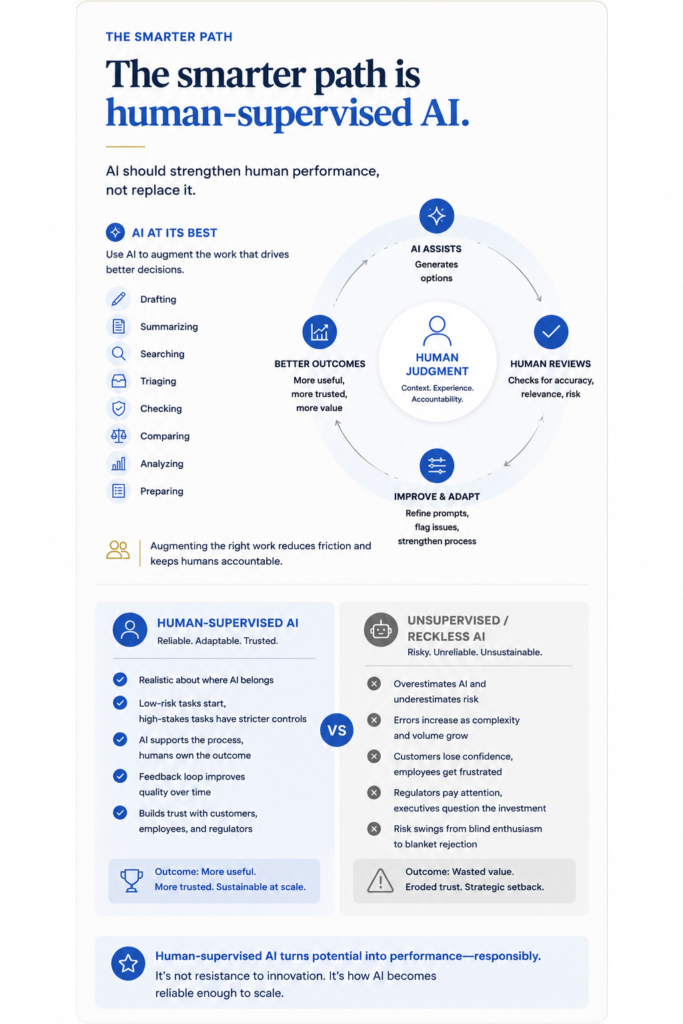
The smarter path is human-supervised AI
The strongest AI strategy is not maximum automation. It is targeted augmentation.
AI should be used where it strengthens human performance: drafting, summarizing, searching, triaging, checking, comparing, analyzing, and preparing work for human decision-makers. It should reduce friction, not remove accountability.
That means organizations need to be realistic about where AI belongs. Low-risk, repetitive, high-volume tasks are often good starting points. High-stakes decisions require stricter controls. In sensitive areas, AI should support the process, not own the outcome.
This is not resistance to innovation. It is how AI becomes reliable enough to scale.
Human-supervised AI creates a feedback loop. People catch errors, refine outputs, improve prompts, flag edge cases, and help the system adapt to real-world conditions. Over time, that makes AI more useful and more trusted.
By contrast, replacing humans too quickly can produce the opposite effect. Errors increase. Customers lose confidence. Employees become frustrated. Regulators pay attention. Executives question the investment. Then organizations risk swinging from blind enthusiasm to blanket rejection.
That overcorrection would be damaging. AI has too much value to be wasted through reckless deployment.
The smarter path is human-supervised AI
The strongest AI strategy is not maximum automation. It is targeted augmentation.
AI should be used where it strengthens human performance: drafting, summarizing, searching, triaging, checking, comparing, analyzing, and preparing work for human decision-makers. It should reduce friction, not remove accountability.
That means organizations need to be realistic about where AI belongs. Low-risk, repetitive, high-volume tasks are often good starting points. High-stakes decisions require stricter controls. In sensitive areas, AI should support the process, not own the outcome.
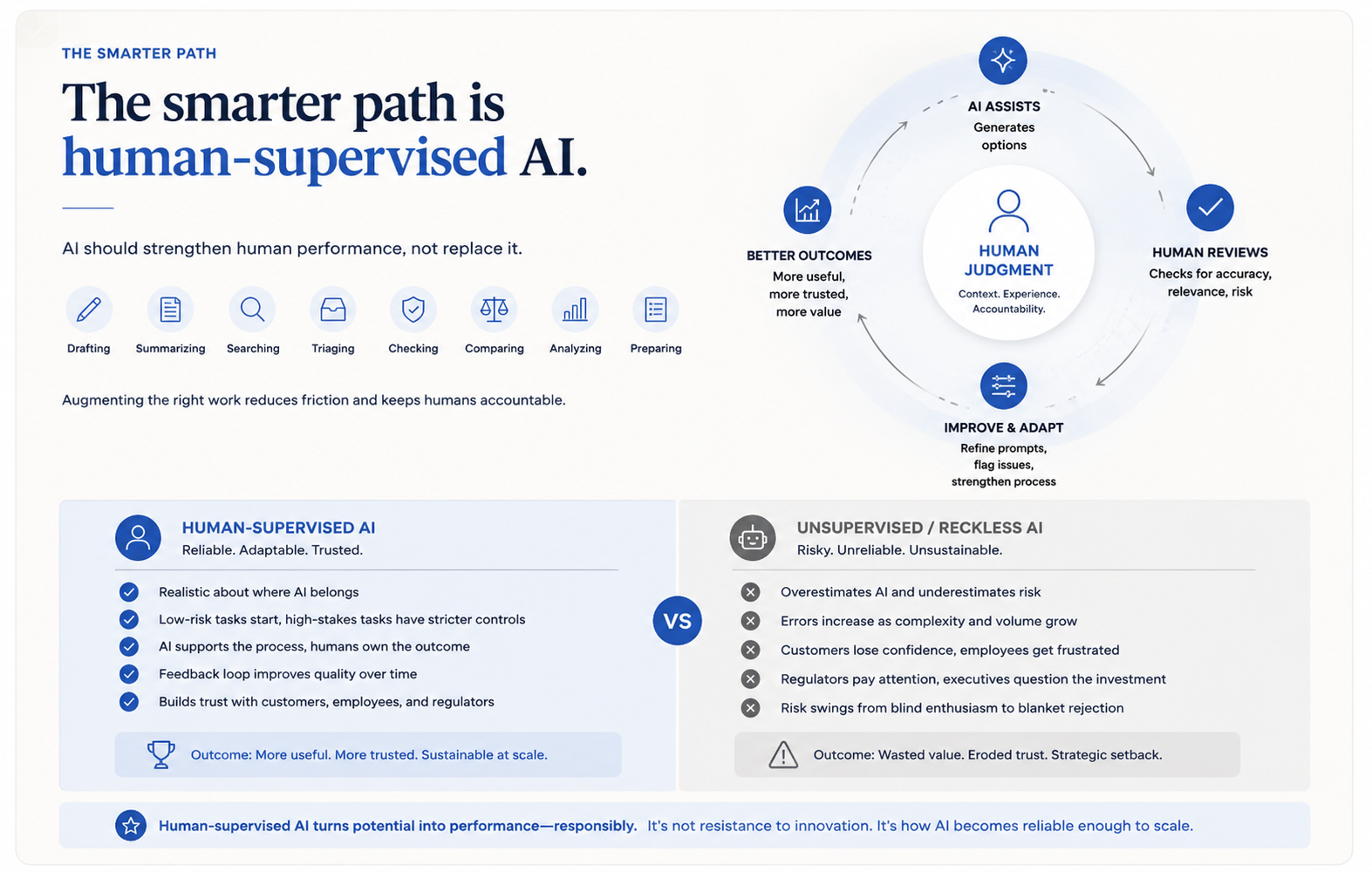
This is not resistance to innovation. It is how AI becomes reliable enough to scale.
Human-supervised AI creates a feedback loop. People catch errors, refine outputs, improve prompts, flag edge cases, and help the system adapt to real-world conditions. Over time, that makes AI more useful and more trusted.
By contrast, replacing humans too quickly can produce the opposite effect. Errors increase. Customers lose confidence. Employees become frustrated. Regulators pay attention. Executives question the investment. Then organizations risk swinging from blind enthusiasm to blanket rejection.
That overcorrection would be damaging. AI has too much value to be wasted through reckless deployment.

The point is productivity
The future of AI will not be won by companies that remove humans fastest. It will be won by companies that make humans more capable.
That is the message businesses need to hear clearly.
AI is a productivity tool. It is not a replacement strategy.
Its best use is not to strip people out of the process, but to give them more leverage. Let AI handle the repetitive work, accelerate the first draft, surface the pattern, summarize the noise, and prepare the options. Let humans bring the judgment, context, empathy, responsibility, and understanding of consequence.
When AI is treated as a human replacement, it becomes fragile. It is asked to carry weight it cannot yet support. It makes mistakes that people do not catch. It creates distrust. And eventually, the backlash limits the very progress AI was supposed to deliver.
But when AI is treated as a productivity layer under human supervision, it becomes powerful. It helps teams move faster without surrendering control. It improves output without pretending judgment can be automated away. It creates confidence because people remain accountable for the result.
That is the path forward: not less AI, and not blind AI everywhere.
Better AI. Supervised AI. Human-led AI.
The organizations that understand this will get the value. The ones that do not will get the lesson.