
Vernex Analysis Feature
THE CONTENT STORE APPROACH
Every piecve of content has a purpose
Give specialist audiences the deeper evidence, market context and technical detail they need to properly evaluate the announcement.
It explains the underlying customer problem, adds proof points and expands on the technical or operational issue behind the launch.
It supports sales conversations, gives PR extra substance and creates a destination for readers who need more than top-level messaging. Use in sales outreach, analyst briefings, newsletters, retargeting journeys and follow-up social posts aimed at more technical audiences.
Breaking down the numbers
AI is an
absolute
necessity
Artificial Intelligence is increasingly cast as the villain of the labour market. That is too simple, and it lets organisations avoid the harder question. The problem is not AI, it is the adoption itself.
The adoption of Artificial Intelligence is generally being received negatively, but when you examine the numbers driving the telecoms infrastructure segment, Artificial Intelligence is a lifeline not a luxury.
At some point across the last decade, connectivity became a necessity for the basic function of society and its citizens. The actual when is largely irrelevant, digital technologies have become so entwined in everyday life it is almost impossible without it.
Banking is digital, CVs are sent online, shops are going cashless, people are stranded without mapping applications, not to mention our dating lives start virtually, we no longer need to live within commuting distance of the office and online shopping is arguably the new norm.
All this happens thanks to the communications networks. The infrastructure the vast majority give no second thought to. These networks are critical, but the equation isn’t balanced.
Telcos are constantly under pressure. Keeping a network both operational and profitable is a tightrope walk. If the thing holding everything together is holding on for dear life, society finds itself in a rather precarious position.
AI might be considered a buzzword for many, but for telecoms operators the integration of AI is an absolute necessity to keep the lights on.
The precarious position of telcos
There aren’t many people who would offer sympathy to companies worth billions making less profit each year, but this is the position telcos find themselves in.
Despite the importance of communications networks increasing over the last 15 years (not that they weren’t important before then), making money has become increasingly difficult.
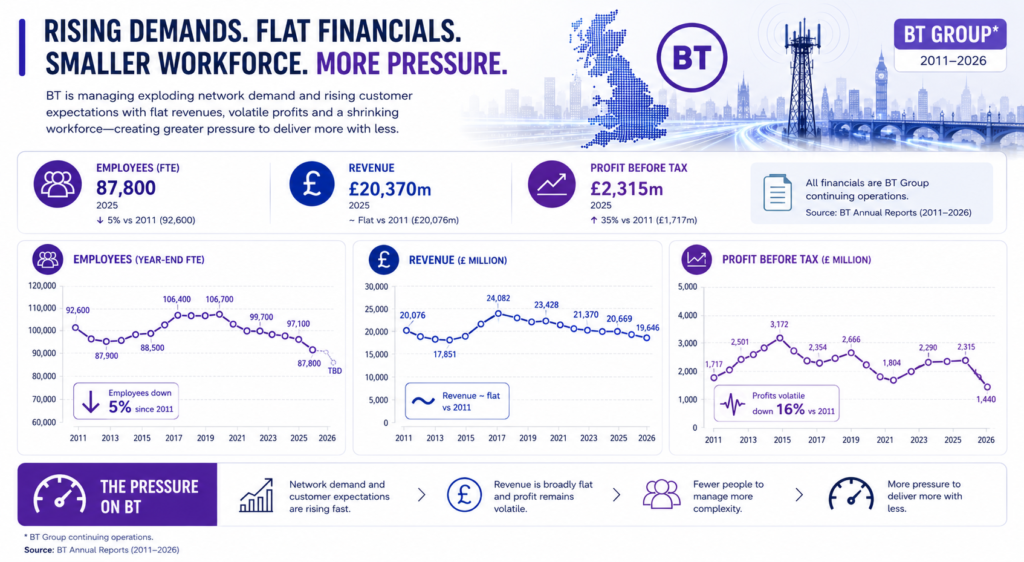
What you must appreciate is that these are for-profit businesses which have a fiduciary responsibility to make money for investors.
Again, we might break out the worlds’ smallest violin, but let’s not forget, we might have a selfish interest in these companies being successful. Some of the biggest investors in telecoms companies are hedge funds or pension schemes.
We also need these companies to be financially successful to ensure they are able to reinvest in themselves to improve the infrastructure itself.
The rising tides of digital data
Unfortunately for the telecoms operators, the pressure is two-fold.
Customers want more but are reluctant to pay more, an unforgiving situation which the telecoms industry largely created itself with the introduction of “unlimited” contracts.
There are very few other sectors which have to live under the same conditions. Customers can largely consume as much of the product (connectivity) as they like without having to pay more.
An interesting comparison is the automotive industry.
If a car manufacturer equates to a communications device, then the telco operators are the energy companies – they provide the “fuel” which keeps the car running. But, if you were to drive a car twice as much as your neighbour, you would expect to pay twice as much for fuel.
That’s not how it works in the telco industry (for unlimited contract anyway). You and your neighbour could both have a £25 a month contract with a communications service provider, but that is not a precise representation of how much data each would use. It doesn’t have to be the same.
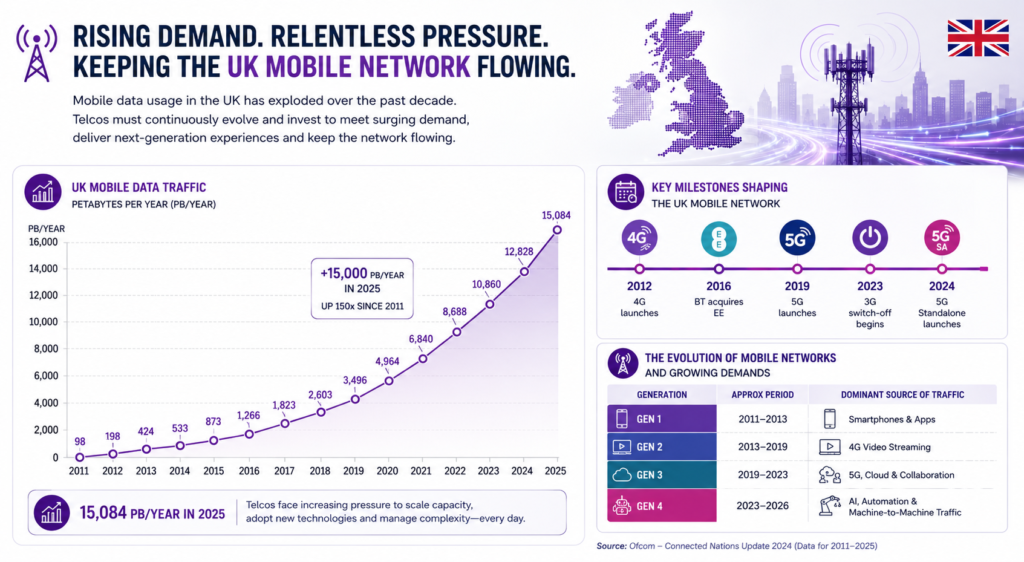
As a society, we are addicted to data, and to keep up with demand, telcos are increasingly investing more into their infrastructure.
According to data from the Department of Science, Innovation and Technology, traffic increased by 495% between 2018 and 2025, whereas the adjusted price of mobile services decreased by 25%.
If telcos are being asked to do more, but the financial situation is not enabling them to expand the workforce, is this a balanced equation which will lead to success?
No, it is not.
AI a necessity not a luxury
At Vernex, we believe in augmentative power of AI. This is not a technology which should replace human capability but enhance it.
AI should be used as a tool to ensure humans are able to operate as efficiently as possible. Whether this is undertaking the monotonous jobs, analysing troves of seemingly uncomprehensible data for insight or simply parsing documents for relevant information.
It frees human resource to concentrate on more value-added tasks for the organization. The tasks AI cannot yet do because it requires unprogrammed experience, empathy or an understanding of the laws of unintended consequences.
If the digital economy is to succeed, telcos cannot continue down the same path. They need to be financially successful to ensure reinvestment into the infrastructure, which will provide the catalyst for society to evolve further.
AI is key to this objective. Without it, the weight of demand and expectation will simply become too much, and we will sleepwalk into a position of mediocrity, both in terms of network performance, and the economic benefits which rely on world-class communications infrastructure.
Therefore, in the telco world, AI was never a luxury, it was in fact a necessity years ago, but innovation hadn’t caught up with the market requirements
Bring us the raw thinking
And we'll turn it into a content marketing plan which engages across different platforms and audience profiles
Tell us the idea
And we'll show you how you can layer the argument, build in redundancy, and support other channels