
Vernex Explainer
THE CONTENT STORE APPROACH
Every piecve of content has a purpose
Answer the practical questions buyers are already asking before they are ready to speak to sales or read product messaging.
It explains a complex topic in plain language, breaking down what it means, why it matters and how it applies in the real world.
It supports search, AI discovery, social education and sales enablement by creating a useful entry point into the topic. Optimise for search, share as educational LinkedIn content, use in email nurture journeys and link from related product or insight pages.
What is AIOps in telecoms?
AIOps in telecoms uses artificial intelligence, machine learning and operational data to help operators detect, understand and respond to issues across complex communications networks.
The term stands for artificial intelligence for IT operations, but telecoms creates a more demanding environment than standard enterprise IT. Operators are managing radio access networks, fibre routes, transport links, core platforms, cloud infrastructure, customer services, operational support systems and service assurance tools.
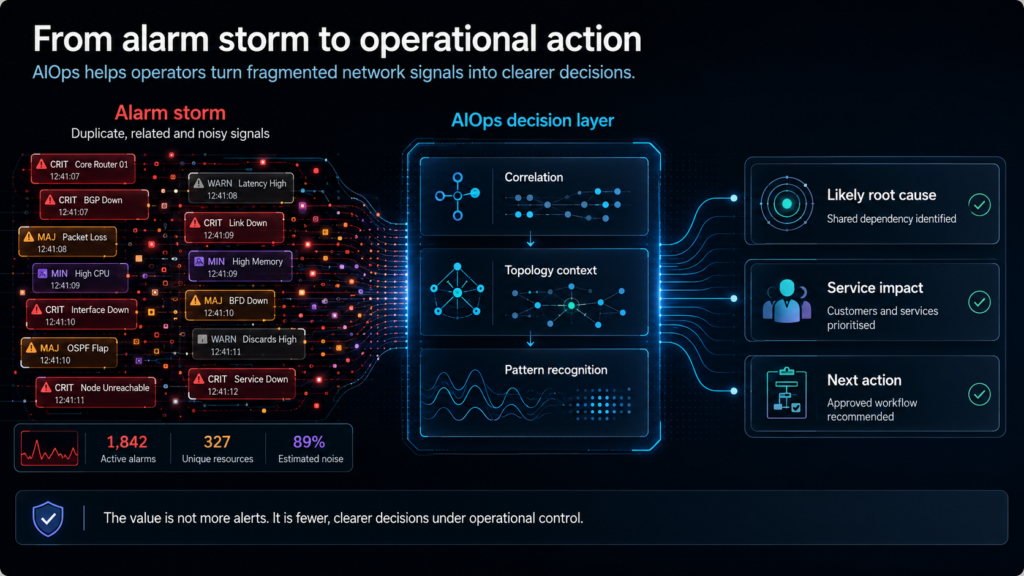
Each layer generates alarms, logs, events, telemetry and performance data. When something goes wrong, the network operations centre can be flooded with signals. The challenge is not simply spotting that something has happened. It is understanding what matters, what caused it, who is affected and what should happen next.
How does AIOps work in a telecoms network?
AIOps platforms collect operational data from multiple network systems, then use analytics and machine learning to identify patterns. This can include alarm correlation, anomaly detection, topology mapping, service-impact analysis and root-cause recommendation.
For example, one transport fault may trigger alarms across several mobile sites. Without AIOps, engineers may investigate each alarm separately. With AIOps, related events can be grouped together, duplicate alarms can be suppressed and the likely root cause can be prioritised.
That turns hundreds of alerts into a smaller number of actionable incidents.
What problems does telecoms AIOps solve?
AIOps is most useful where operators face high volumes of operational data and repeatable fault patterns. Common use cases include alarm deduplication, root-cause analysis, ticket enrichment, repeat-fault detection, incident prioritisation, change validation and workflow automation.
It can also help teams understand whether an issue is likely to affect customers, enterprise services, a specific region or a high-priority part of the network.
In one fictional deployment, regional operator Northline Mobile used Vernex Automate to analyse recurring alarm storms across its transport network. EventIQ grouped related alarms, identified shared dependencies between affected sites and reduced duplicate alarm noise by 72% during the pilot.
What is the difference between AIOps and automation?
AIOps helps the operator understand what is happening. Automation helps the operator act on it.
The two are closely connected. AIOps may identify the likely cause of a fault and recommend a next step. Automation can then create a ticket, assign the right team, trigger an approved workflow or carry out a low-risk corrective action.
In more advanced environments, this becomes closed-loop operations. The system detects an issue, recommends or takes action, checks whether the fix worked and records the outcome.
For example, fictional fibre provider HarbourNet used FlowOps to automate ticket enrichment and approval workflows for repeat access-network faults. Engineers still approved service-impacting actions, but standard diagnostics and escalation steps were triggered automatically.
Why does AIOps matter for telecoms operators?
Telecoms networks are becoming too complex to manage through manual processes alone. Operators need to improve reliability, reduce operating costs and protect customer experience while dealing with more systems, more data and more dependencies.

The best AIOps deployments are controlled. They use confidence scores, approval gates, role-based permissions, audit trails and rollback options, especially where actions could affect live services.
AIOps gives operators a practical way to cut through complexity. It helps network operations teams reduce alarm noise, identify faults faster and build a safer path towards closed-loop operations.
In telecoms, where networks are critical infrastructure, that distinction matters.
Bring us the raw thinking
And we'll turn it into a content marketing plan which engages across different platforms and audience profiles
Tell us the idea
And we'll show you how you can layer the argument, build in redundancy, and support other channels