
Vernex Viewpoint
THE CONTENT STORE APPROACH
Every piecve of content has a purpose
Use the announcement to make a broader argument about the market, rather than simply repeating the product message.
It gives the spokesperson a clear perspective on the industry problem, showing why the launch matters in a wider commercial context. It also helps to humanize the message, allowing customers to connect with people not just a brand
It strengthens executive visibility, gives social teams sharper opinions to promote and supports PR with a stronger narrative angle. Publish through the executive’s LinkedIn profile, cut into social posts, use in media pitching and link from launch-related content.
Efficiency without judgement is not resilience
Artificial Intelligence is increasingly cast as the villain of the labour market. That is too simple, and it lets organisations avoid the harder question. The problem is not AI, it is the adoption itself.

Somewhere in the rush to prove productivity gains, AI has started to look less like a tool to strengthen human capability and more like a shortcut to workforce reduction. That shift matters. When technology is introduced as progress but experienced as displacement, trust begins to break down.
AI should make us better, not simply cheaper.
In the 1950s when great thinkers like Alan Turing or Arthur Samuel envisioned the concept we now know as Artificial Intelligence (AI), the objective was to supplement human endeavor with technology. The key word here is supplement.
That distinction now is important as public discourse has drifted. We lost our way with many organisations treating it as a headcount alternative.
AI is still sold in the language of productivity, but too often lands with employees as a story of headcount reduction. The gap between what organisations promise and what people experience is where trust starts to fracture.
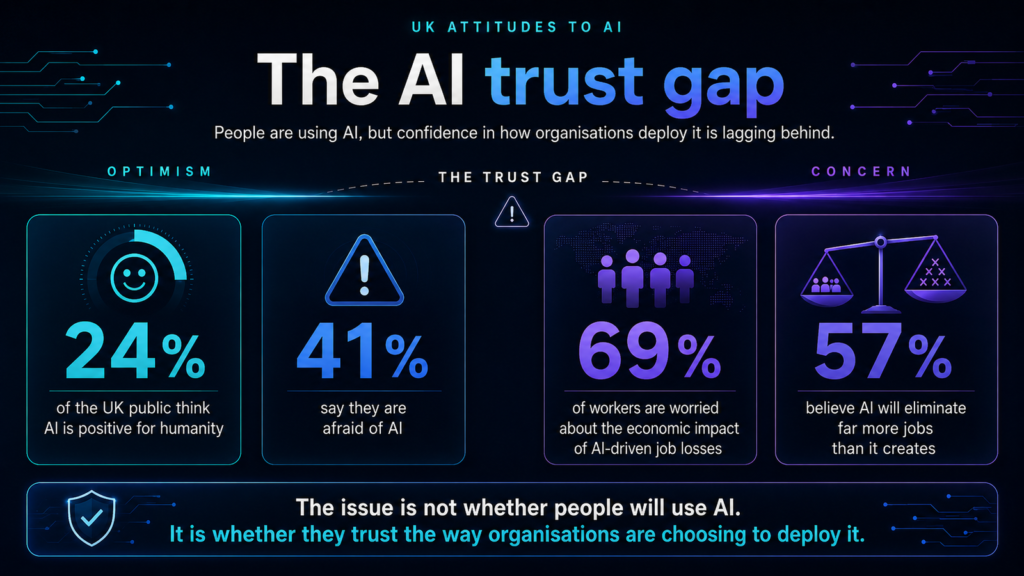
Recent research from Kings College London suggests only 24% believe AI will be positive for humanity. Only 19% believed AI has more advantages than disadvantages.
This is not a technological issue; it is an adoption one.
AI is more than the story people are being told
Part of the perception challenge is driven by what people see.
Job losses. Failed deployments. Overhyped promises. The Terminator. The Matrix. AI has been given a cultural role before many people have had a practical experience of it: clever, threatening and probably coming for someone’s job.
If we go back to the original thesis for AI, the objective was for the technology to solve problems we are not capable of fixing. This does not mean we are redundant; we simply have our advantages and shortcomings.
For example, we are advanced enough to create AI, but not advanced enough to recreate the human brain in its entirety because we still do not fully understand it.
AI can generate, combine and analyse at extraordinary scale. But it does not carry responsibility. It does not understand consequences in the way people do. That is why the goal should not be to remove humans from the loop, but to make the loop work better.
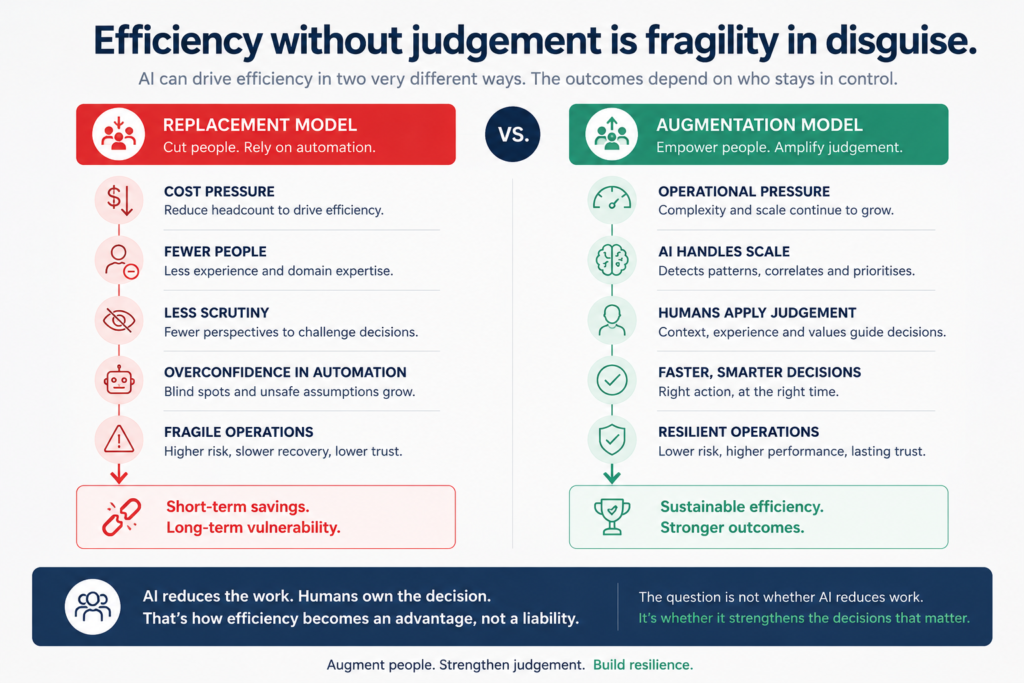
That is where the distinction between replacement and augmentation becomes important. It can support better decisions, but it should not be treated as a substitute for human understanding.
The question, therefore, is not whether AI should be used, but what role we are asking it to play.
Blending human innovation with AI’s raw power
This is where the argument becomes practical.
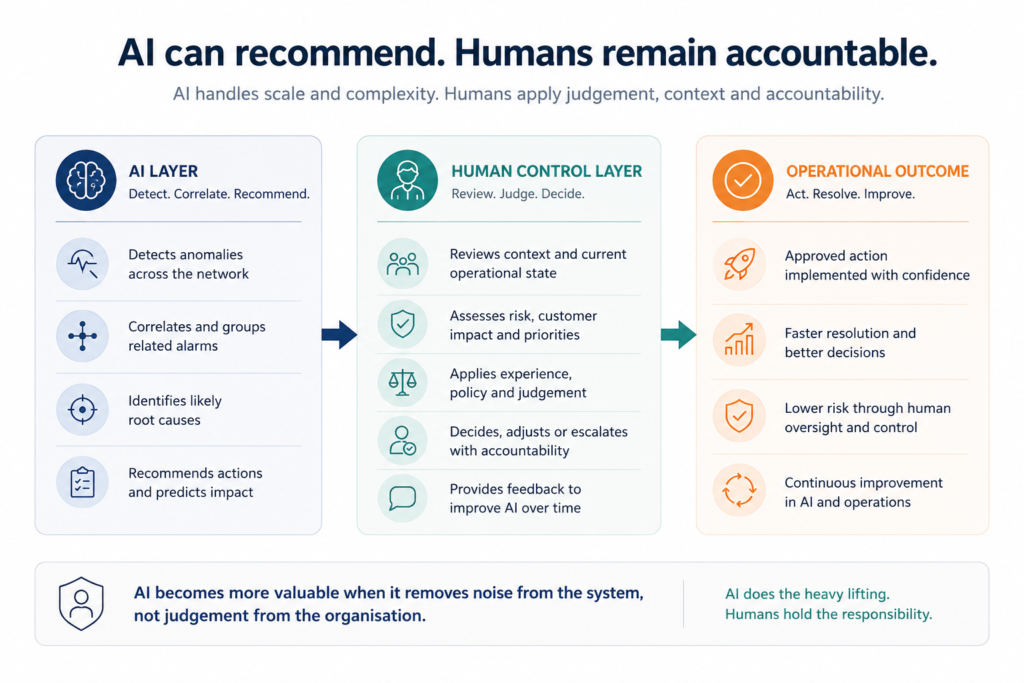
At Vernex, our approach is built around a simple principle: AI should take on the work machines are best suited to, so people have more time and space to do the work only people can do.
Communications infrastructure is becoming increasingly complex, and it is too much for humans to manage independently.
A mobile network, for instance, is made up of thousands of masts, thousands of kilometers of wiring, tens of thousands of servers. It connects millions of people, tens of millions of devices and hundreds of millions of applications. It is threatened by state-sponsored actors, professional cybercrinimals and hackers looking to make a name for themselves.
And all of this is expected to be managed by human engineers, 24 hours a day, who have to sleep, eat and enjoy their lives at some point as well.
This is where the human/AI dynamic becomes much easier to visualize. Not because people are failing, but because the system has grown beyond what any team can manually process in real time.
Every system creates monitoring data. When something goes wrong, the network operations centre can be flooded with alarms. Vernex helps to understand what is happening in the network by grouping related alarms and identifying likely root causes, recommending fixes with approvals and automate processes.
With alarms potentially going off every couple of seconds, the AI does the hard labour, while the humans are given the opportunity to plan ahead.
That is the difference between replacing people and strengthening them. The aim is not to remove engineering capacity from the loop. It is to stop them spending their working lives fighting fires that intelligent systems can help them understand faster.
Letting AI be AI, so humans can be human
This matters because the wrong adoption model creates the wrong expectations.
If we believe AI is a human replacement today, it will fail. AI is good at what it does, but what it does is limited. It can detect patterns across huge volumes of data. It can recommend actions based on defined signals and previous outcomes.
But it does not understand context in the way people do. It does not carry responsibility. It does not know when the technically efficient answer is not the right answer.
It would be dangerous to give AI too long a leash, we’ve already seen network failures due to poorly written AI code, but that does appear to be where the world is heading.
The risk is that financial pressure pushes organisations towards the wrong version of efficiency: fewer people, less scrutiny and too much confidence in systems that still need human judgement around them. That might look attractive on a spreadsheet, but it is a fragile model for critical infrastructure.
AI might fail not because it is technologically flawed, but because we are misunderstanding its technical limitations, and placing too high expectations on what it can deliver.
AI only entered the mainstream market 2-3 years ago, but we are treating it like a technology which has been around for decades. This opens the door to the dreaded laws of unintended consequences, but also lofty expectations which are potentially never within realistic achievement.
The market needs a bit of a reset with a pragmatic approach. If the market wants AI to succeed, it needs to stop treating human involvement as a cost to be removed and start treating it as the control layer that makes the technology trustworthy.
Let AI be AI, so humans can be human.
Bring us the raw thinking
And we'll turn it into a content marketing plan which engages across different platforms and audience profiles
Tell us the idea
And we'll show you how you can layer the argument, build in redundancy, and support other channels