You can’t win the World Cup with nine players. So why build a marketing strategy without owned media?
The World Cup has kicked off so now is the time to force a football analogy into a marketing article.
The Content Store was founded with the idea that a marketing strategy cannot reach its fullest potential without utilising all the available channels.
No one channel is more important than the other, they just serve different purposes.
Social creates visibility. Earned media builds credibility. Events create moments. Executive communications give the brand a human voice. Newsletters keep known audiences warm. Owned media gives the whole system somewhere deeper to go.
The same is true of a football team.
Some players score. Some create. Some defend. Some hold the shape. Some do the quiet work that makes everyone else look better.
When they work together, the team functions.
The marketing starting XI
In football, each position has a role to play, much like the tactics we employ in a marketing strategy. The goalkeeper is crisis communications, not called on often, but essential under pressure. And up front you have social media, the finisher which turns the big plan into visible moments of attention, engagement and action.
In any team some positions are more visible to the fans, some cost more money, some require prima donna attention, and some do the hard graft making everything else tick along smoothly.
When all are working in sync, the plan works perfectly:
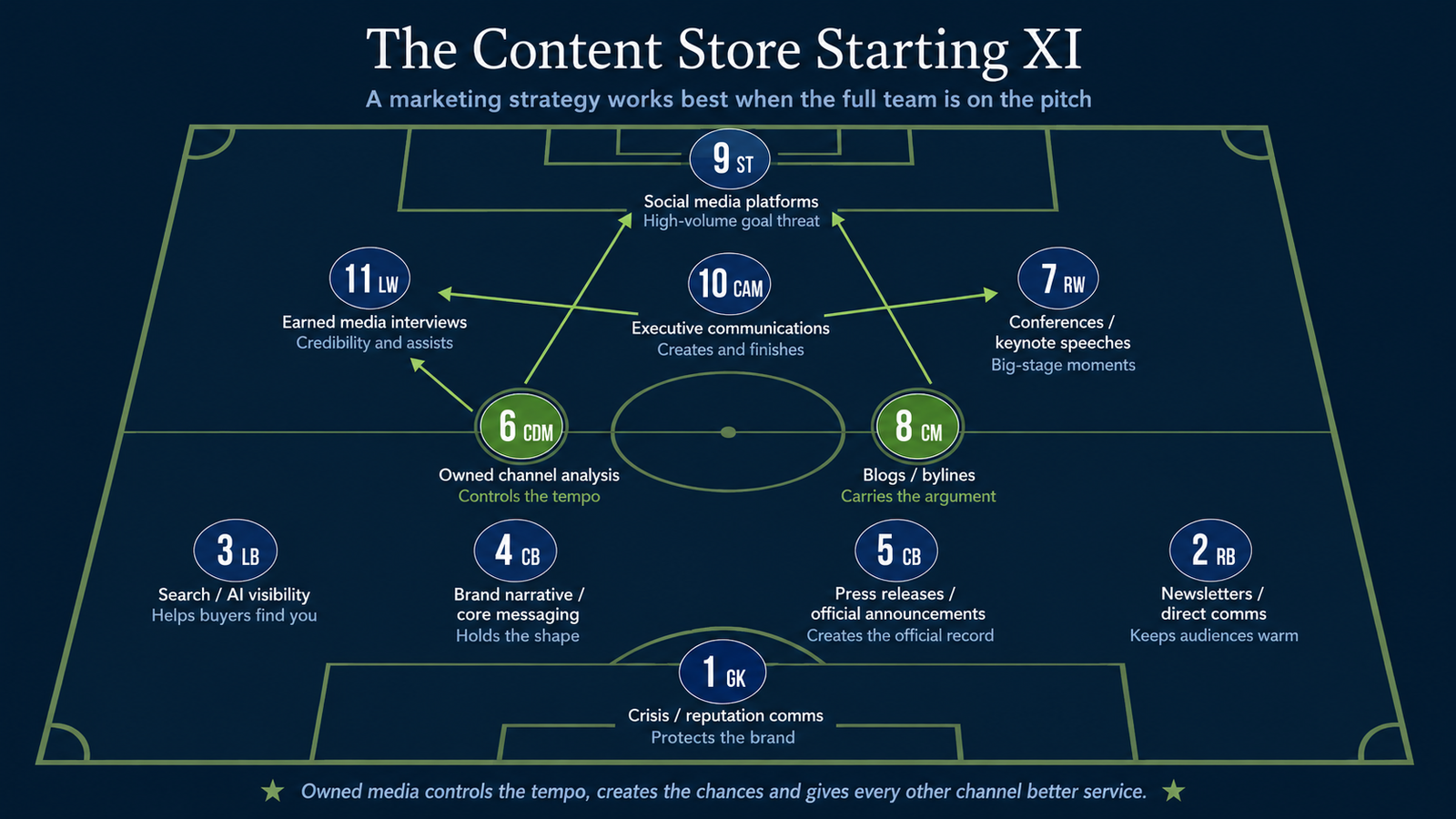
Most companies tend to favour one discipline over the majority, with some being dismissed almost completely. Owned generally falls into the latter, with many simply doing the bare minimum or misunderstanding what the purpose is in the first place.
Much like the football team, can the overarching marketing strategy be as successful as it needs to be when it is missing a pivotal component? Are marketing teams putting a full XI on the pitch?
The midfield that makes the team work
Owned channel content is critical to the success of multiple marketing and communications functions. But it is often the part of the system that gets overlooked or underused.
In football terms, this is the midfield. It controls the game, connects the team and creates the supply line for the players further forward.
There are three roles to consider: the 6, the 8 and the 10.
The 6: Owned channel analysis
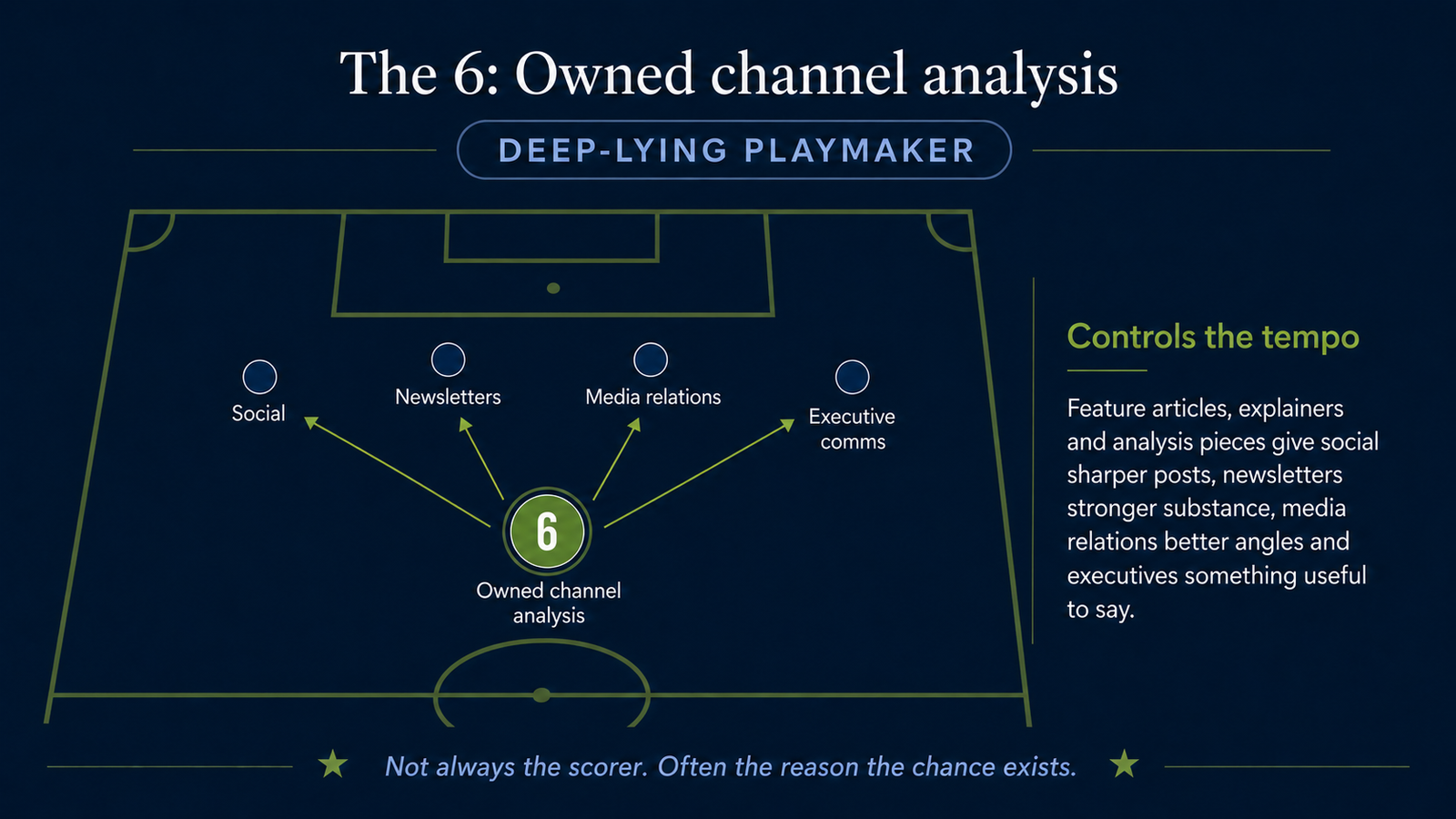
The 6 is the deep-lying playmaker. In this model, that is owned channel analysis: the feature articles, explainers and perspective pieces that build the argument properly.
This is where the brand controls the tempo. A strong analysis piece can assist a social campaign, feed a newsletter, sharpen a media pitch, support a sales conversation or give executives something more useful to say.
It is not always the player that scores. But it is often the reason the chance exists.
The 8: Blogs and bylines
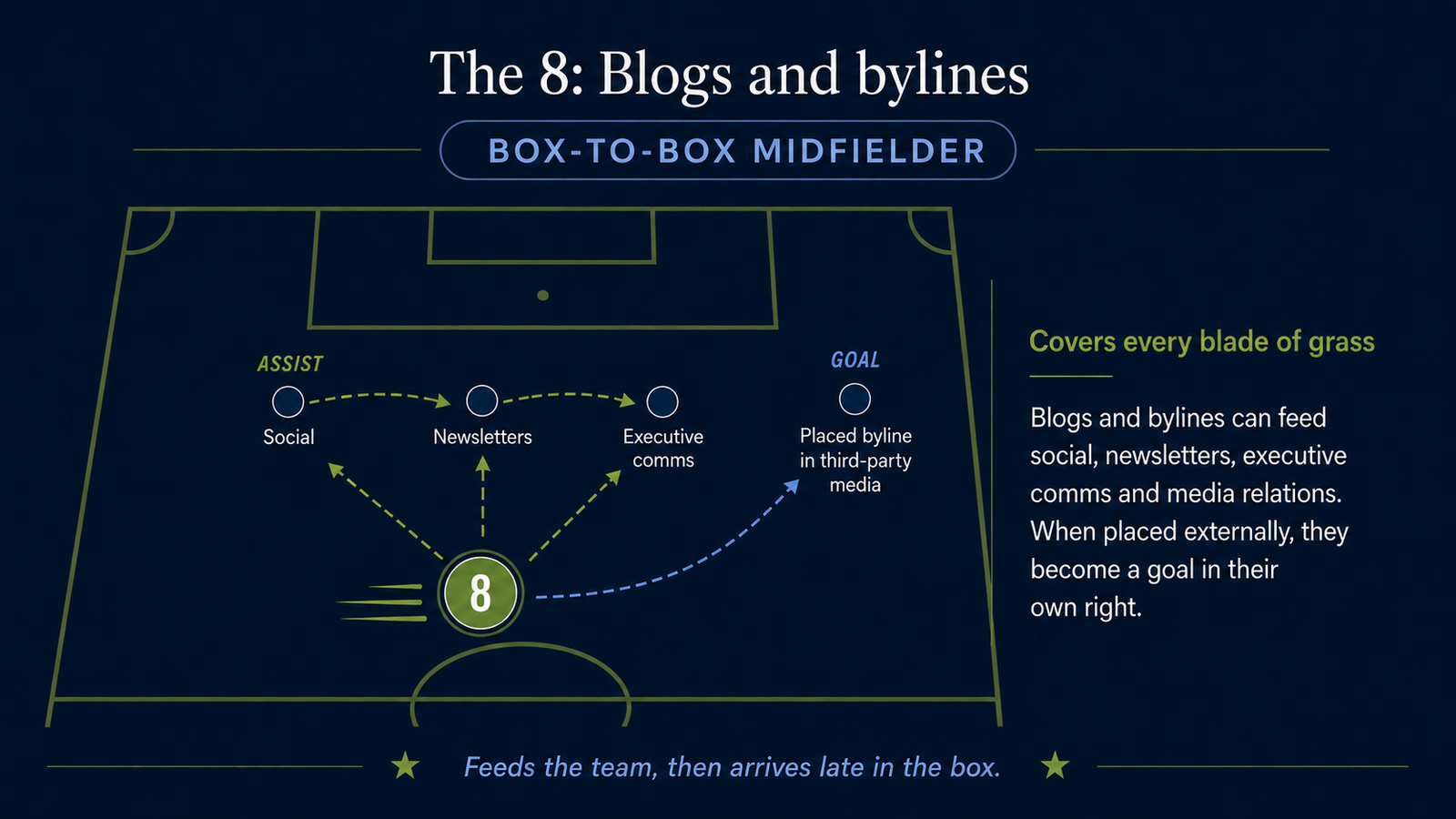
The 8 is the box-to-box midfielder. That is where blogs and bylines sit.
They can receive the ball from owned analysis, carry the argument forward and supply the players ahead of them. A blog can assist social posts, newsletters, executive comms and media relations.
But the 8 can also score. When a byline lands in third-party media, it becomes a goal in its own right: visible, credible and placed in front of an external audience.
The 10: Executive communications
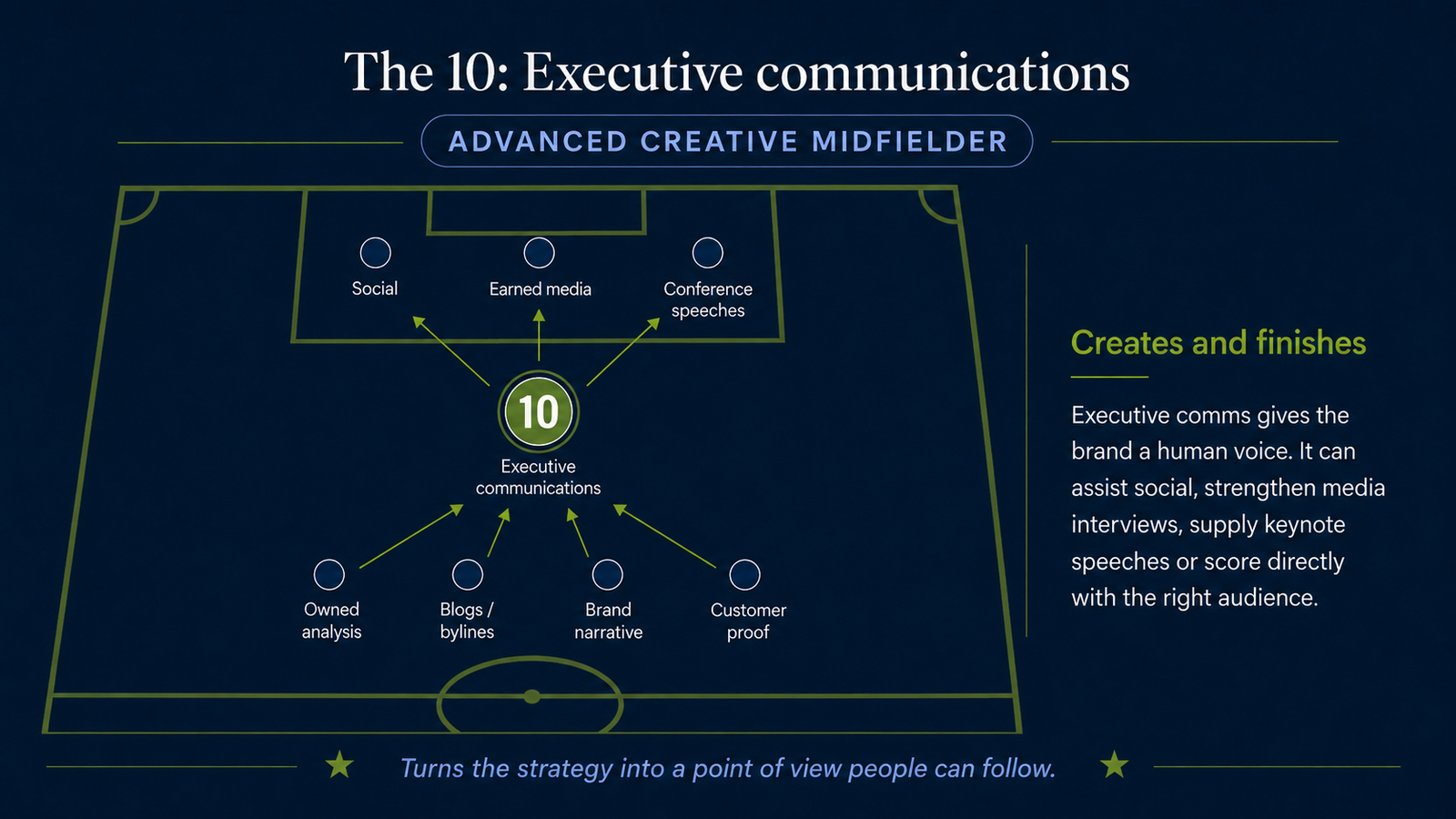
The 10 is the advanced creative role. This is executive communications.
It is often assisted by the owned content behind it: analysis, blogs, bylines, customer proof and a clear brand narrative. From there, it can create or finish.
A strong executive point of view can assist social with more human, opinion-led content. It can give media relations a stronger interview line. It can supply a conference speech. Or it can score directly when an executive lands the message in front of the right audience.
That is the value of owned content in the system. It gives other channels better service while also creating outcomes of its own.
You can’t win the World Cup with nine players
No channel should be asked to win the match on its own. Social creates visibility. Earned media builds credibility. Events create moments. Executive comms gives the brand a human voice. But owned media gives the whole team better service.
Leave it on the bench and everyone else works harder. Social feeds on scraps. Media relations has weaker angles. Executives have less to say. Events land, then fade.
You might nick a result with nine players.
But you do not win the World Cup that way.
Put the full XI on the pitch.
Bring us the raw thinking
And we'll turn it into a content marketing plan which engages across different platforms and audience profiles
Tell us the idea
And we'll show you how you can layer the argument, build in redundancy, and support other channels