Gartner, Muck Rack and numerous others have predicted a PR goldrush in the AI era of queries and crawling, but this assumes media owners will be willing participants in their own demise.
Artificial Intelligence is reshaping marketing and communications faster than we can establish what the new rules are.
What we have seen to date is an ongoing sway of messages as companies jostle for position, each trying to understand their role in the new status quo.
For the PR industry, there has certainly been a fair share of positive news.
Gartner previously predicted PR and earned media budgets would double as AI reshapes search, while Muck Rack has said 84% of AI citations have come from sources it classified as “earned media”. On the surface, this is encouraging for the future of PR in a world increasingly driven by AI search.
However, it assumes two things.
Firstly, the AI search bots will continue to prioritise earned media in response to queries from users. And secondly, the media owners will continue to allow AI to repackage the journalism they pay to produce.
The PR assumption is correct, for today at least
PR agencies building propositions around the concept that earned media will drive greater visibility in AI search have evidence on their side.
Today, AI search does appear to prioritise the credibility of independent media as a source, or at least that is what we can understand from the outside looking in.
In reality, we are looking at the tail of the comet, not the comet itself. We are evaluating where it has been, not where it is. Unless you are working for one of the Frontier AI companies and writing the code, you cannot say for certain how the bots prioritise credibility.
Do AI engines believe trade media is better for technical questions because of specialist knowledge? This is contrary to many PRs and executives, who perhaps are drawn to the glamour of established, international business media.
The PR industry often prioritises hierarchy, but AI search may well prioritise the more contextually relevant media.
We don’t know the answer to these questions, but we can examine the second variable.
Why would media owners contribute to their own demise?
If we assume AI will continue to prioritise earned media in citations, we then have to move to the other side of the equation.
Will media owners allow AI search bots to utilise the content they create on their platforms?
Research from Buzzstream suggests that media owners are pushing back:
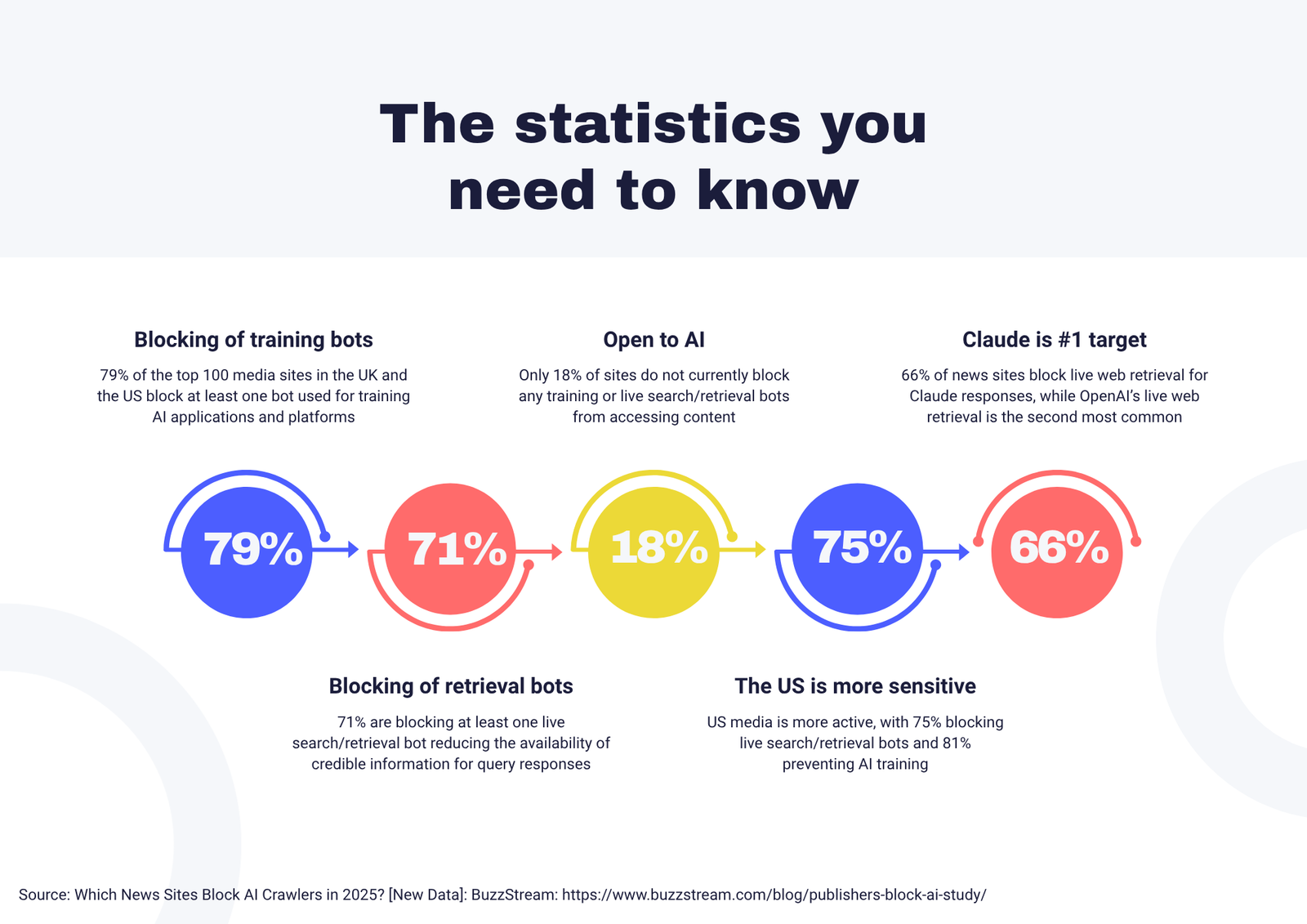
The media industry has been under continued pressure for almost three decades.
Between 2007 and 2017, UK newspaper advertising revenue fell from £4.6 billion to £1.4 billion, while circulation revenues declined from £2.2 billion to £1.7 billion. Audiences did not stop consuming news, they shifted online, and revenues followed.
However, the Competition and Markets Authority found that 80% of the digital advertising revenues in 2019 were directed towards Google and Facebook. These companies are amplifiers of the news, not publishers of it.
Audiences went online, and so did the revenues, but they fragmented.
AI search does not produce news, it derives it from other sites. These sites are subject to the burden of cost, but have to fight the AI platforms for audience attention.
This in itself undermines the PR argument. Earned media will only continue to be a driver of AI discoverability if the media owners allow the AI platforms to benefit from their hard work.
Why would media owners continue to bear the financial burden of credible journalism when the AI platforms are capturing the rewards without offering the equivalent in return?
The reality is probably remarkably more boring. Earned media will contribute, but nowhere near the levels being promised.
Today's assumptions do not make sense tomorrow
Part of the challenge the PR industry faces is not its analysis of the status quo today, but the assumption that it will continue through to tomorrow.
The value of earned media should not be ignored. The credibility brands can drive is as true today as it ever has been, perhaps even more so in a world where people question the validity of what is online. But, this approach is not necessarily transferable in a world dominated by AI search.
The status quo is increasingly driven by the variables. AI search largely relies on information derived from external sources, but those external sources are seemingly pushing back.
If the link between media and AI search is severed, brands cannot afford to rely exclusively on third-party domains to build their authority. The reality of tomorrow is remarkably similar to the reality of yesterday. A balanced approach to marketing and communications is key. Earned drives credibility, paid drives scale, editorial fuels social and direct vehicles to the audience.
Over-indexing on one channel was never a sensible idea, and one channel was never going to solve all ills. If media owners are revolting against the AI overlord, then owning their own voice through a sound editorial strategy allows brands to control their fate.
That is a balanced strategy, not a silver bullet built on variables, influenced by different parties with conflicting goals and interests.
Bring us the raw thinking
And we'll turn it into a content marketing plan which engages across different platforms and audience profiles
Tell us the idea
And we'll show you how you can layer the argument, build in redundancy, and support other channels
Sources
Graphic One: The statistics you need to know
Which News Sites Block AI Crawlers in 2025? \[New Data\]
BuzzStream examined the robots.txt files of leading UK and US news websites, ranked by Similarweb traffic, to assess restrictions placed on 11 AI crawlers. The study found that 79% blocked at least one AI-training bot, 71% blocked at least one live-search or retrieval bot, and 67% blocked Perplexity’s indexing crawler. However, robots.txt files are directives rather than technical barriers, so the results primarily demonstrate publisher intent, not whether AI systems can access the content by other means
https://www.buzzstream.com/blog/publishers-block-ai-study/