Few will admit it in public, but AI-generated content is quickly becoming the norm. But how many professionals actually appreciate the potential risk? Faster and cheaper is very rarely better, and in the case of AI Slop, it is often just useless.
Artificial Intelligence (AI) has many advantages. It has the potential to make employees more productive, can unearth insight beyond initial assumptions, and can ensure a focus on value not volume.
But scrolling through any LinkedIn feed today, it is clear that many have gone beyond viewing AI as an augmentation of human capabilities, instead, using it entirely as a replacement. Welcome to the White Noise Wall of AI Slop.
For context and transparency, your author does use AI. Working alone from the boxroom of a London terraced house, ChatGPT can offer significant benefits.
The AI agent is a research assistant, doing the grunt work of poring through news sites and academic journals to find supporting evidence. It is an editorial sounding board, rounding out ideas by asking small batches of questions and probing arguments. It acts as a reviewer of work, comparing the final draft to the original brief to assess whether the outcome matches the intended objectives.
This is where AI provides value, not in replacing the ability to construct a piece of content designed to inform, engage and entertain, but by adding a layer of capability around the human experience. Without it, support would be required from the Author’s wife (who has little interest in technology or telecommunications), two children not yet old enough to walk to the shop on their own, or a cockapoo.
But how many people go beyond this intended usage of AI agents, and how many are aware of the risk this poses thanks to the introduction of new approaches on social media platforms intended to identify what users consider to be AI Slop?
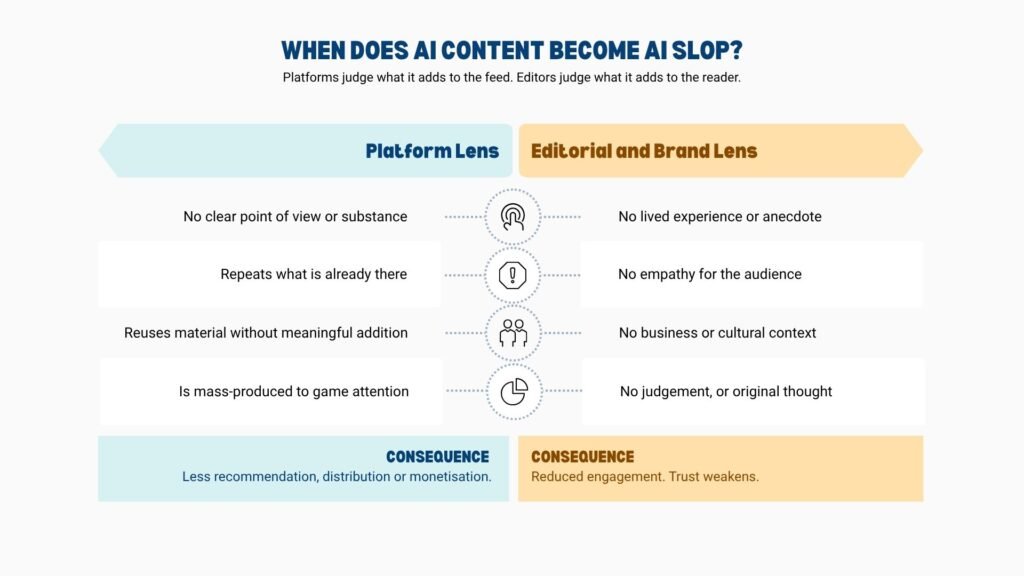
Fighting back against AI Slop
Whether the social media platforms genuinely care about AI Slop or not is a matter of personal opinion, but you can almost guarantee they are very concerned about anything which would impact user experience on their platforms.
Social media platforms only survive if people are scrolling and engaging with the content hosted on the feeds. If the audience stops engaging, advertisers are less likely to invest, removing one of the biggest revenue incentives for the platform owners.
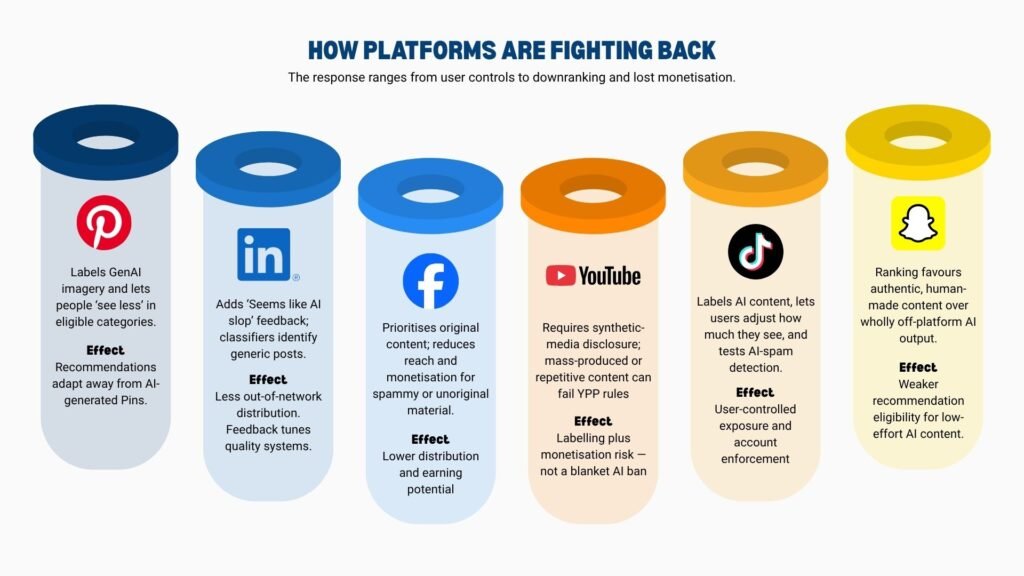
As a result of the growing White Noise Wall of AI Slop, several platform owners acted:
What are the consequences for the sloppiest content creators?
Creators, publishers and amplifiers of AI Slop will not immediately see the negative impact show up on the KPI dashboards, which is perhaps as concerning as anything else.
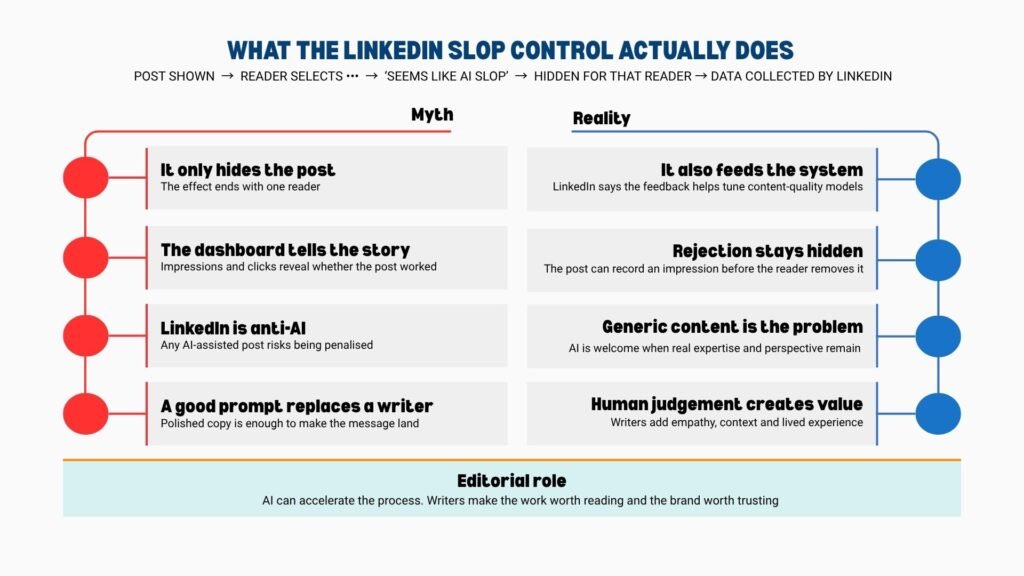
If you have an issue, you want to know about it so you can compensate for it. But that is not what will happen here. The risk is a blind stagger towards a potentially irreversible position. Take LinkedIn as an example.
By clicking on the three dots at the top of a post, the audience is able to report AI Slop. This immediately hides the piece of content from that user, but it does not send a notification to the owner of the Slop. With two clicks, the piece of content has failed for that individual, but the owner of the content is none the wiser.
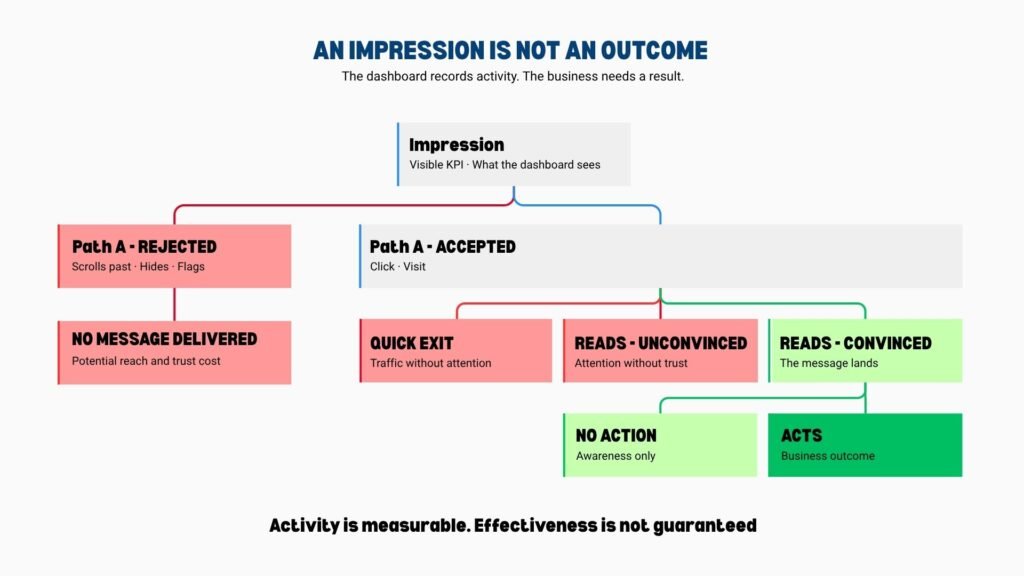
Looking at the analytics, it would still appear as an impression, and potentially a visit (perhaps the Slop reporter read some of the piece to identify it as Slop). The dashboard records exposure, but not the rejection.
But this false sense of accomplishment is not all that is at risk. This piece of content might fail, but you might also find future pieces of content disadvantaged in the future.
LinkedIn is plans to start working on private analytics indicator which will show if the audience feels content is inauthentic or overly reliant on AI. However, an aggregated dashboard is not the same as seeing when and why an individual reader rejected the content.
Why the KPI dashboard rewards AI Slop
Anecdotally, you could argue that the increase in AI Slop is down to three things: time pressure on employees, companies not employing the right skill sets, and the desire to be an AI company.
Firstly, with many companies facing increased financial pressure, employees are asked to do more with the same time and resources. To meet these new expectations without sacrificing their personal lives, employees search for new tools.
Secondly, in the marketing and communications world, things are getting harder. There are fewer journalists and more PRs, meaning diminishing returns on earned media activities, while publishers are increasingly recognising the value of their properties, meaning paid media becomes more expensive. Marketing and communications departments are trying new ideas, such as an editorial approach, without employing the right people or giving them the room to operate with editorial discipline.
Finally, the desire to remain relevant. If you cannot show your CEO that you are embracing AI, then are you even doing your job properly? This pressure to show you are on trend means AI is embraced in the easiest, not the best way.
When you start producing high volumes of content via AI, and distributing at speed, the KPI dashboard looks productive. More articles on the website, more impressions on LinkedIn posts, higher traffic.
But then again, does it actually do the job?
AI reduced the cost of producing content, but it also flooded platforms with material audiences do not want. Platforms are now responding by allowing people to reject it, and then limiting its distribution based on this feedback.
What companies have saved on time and budget looks less impressive when it achieves little.
The danger no one sees
AI Slop is faster and cheaper to generate, which looks attractive under the most simplistic of corporate analysis.
But when you sacrifice quality for speed and cost, you are gaining superficial impact, while potentially breaking the trust customers have in your brand.
The idea of pumping KPIs and believing that will directly correlate with perceptions of an organisation is flawed. A click does not guarantee the reader reached the call to action, or that the argument was delivered in a sufficient manner for the reader to be convinced.
But perhaps the biggest risk is the sour taste in the mouth of the reader. Research from Gartner suggests 50% of customers would prefer to give their business to brands that do not use generative AI in market-facing content. That draws a pretty clear line between AI-generated content and trust in a brand.
Interestingly enough, 68% of the same respondents frequently wonder whether the content and information they see is real. The fact they are asking the question at all suggests trust is already becoming fragile.
AI has its place, and can offer very valuable contributions to the way in which individuals work, but marketers and communications professionals who believe faster and cheaper is better, or that they have nailed their prompts so it looks like a human has written it, are perhaps sleepingwalking themselves into a difficult position.
Customer trust may be damaged, while LinkedIn is already limiting the wider distribution of content it identifies as generic or low value. The reward does not seem to outweigh the risk.
Customer trust may be damaged, while LinkedIn is already limiting the wider distribution of content it identifies as generic or low value. The reward does not seem to outweigh the risk.
Bring us the raw thinking
And we'll turn it into a content marketing plan which engages across different platforms and audience profiles
Tell us the idea
And we'll show you how you can layer the argument, build in redundancy, and support other channels
Sources
Graphic One: When does AI content become AI Slop
https://www.linkedin.com/help/linkedin/answer/a15410007
https://www.linkedin.com/help/linkedin/answer/a1481496/best-practices-for-content-created-with-the-help-of-ai
https://news.linkedin.com/2026/keeping-conversations-real-on-linkedin
Graphic Two: How platforms are fighting back
https://support.google.com/youtube/answer/1311392
https://values.snap.com/policy/content-guidelines-recommendation-eligibility/recommendation-eligibility/quality
https://www.linkedin.com/help/linkedin/answer/a15410007
Rewarding Original Creators on Facebook
Cracking Down on Spammy Content on Facebook
https://newsroom.pinterest.com/en-gb/news/pinterest-rolls-out-new-tools-to-give-users-more-control-over-gen-ai-content/
https://support.google.com/youtube/answer/14328491
https://newsroom.tiktok.com/helping-people-spot-and-understand-ai-generated-content-on-tiktok
Graphic Three: What the LinkedIn slop control actually does
Author’s product test, 14 August 2026
This is the source for the immediate disappearance of the selected post from your feed. LinkedIn’s public documentation describes the feedback control but does not explicitly document this final screen behaviour.
https://www.linkedin.com/help/linkedin/answer/a15410007
https://www.linkedin.com/help/linkedin/answer/a1481496/best-practices-for-content-created-with-the-help-of-ai
https://news.linkedin.com/2026/keeping-conversations-real-on-linkedin
https://www.linkedin.com/posts/hsrinivasan1_ai-slop-is-a-top-priority-for-all-of-us-activity-7488612009660346374-xZiY/
https://www.linkedin.com/help/linkedin/answer/a564051
Graphic Four: An impression is not an outcome
https://www.linkedin.com/help/linkedin/answer/a564051